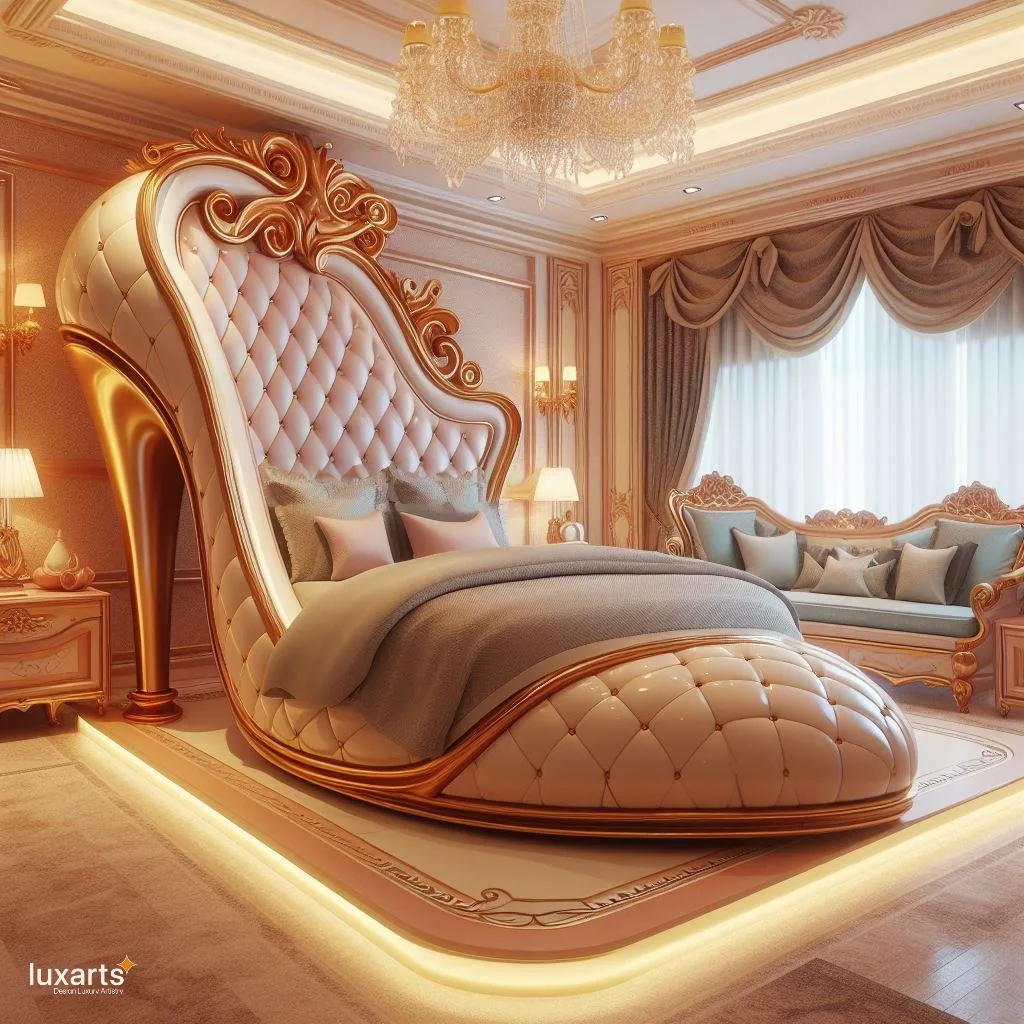
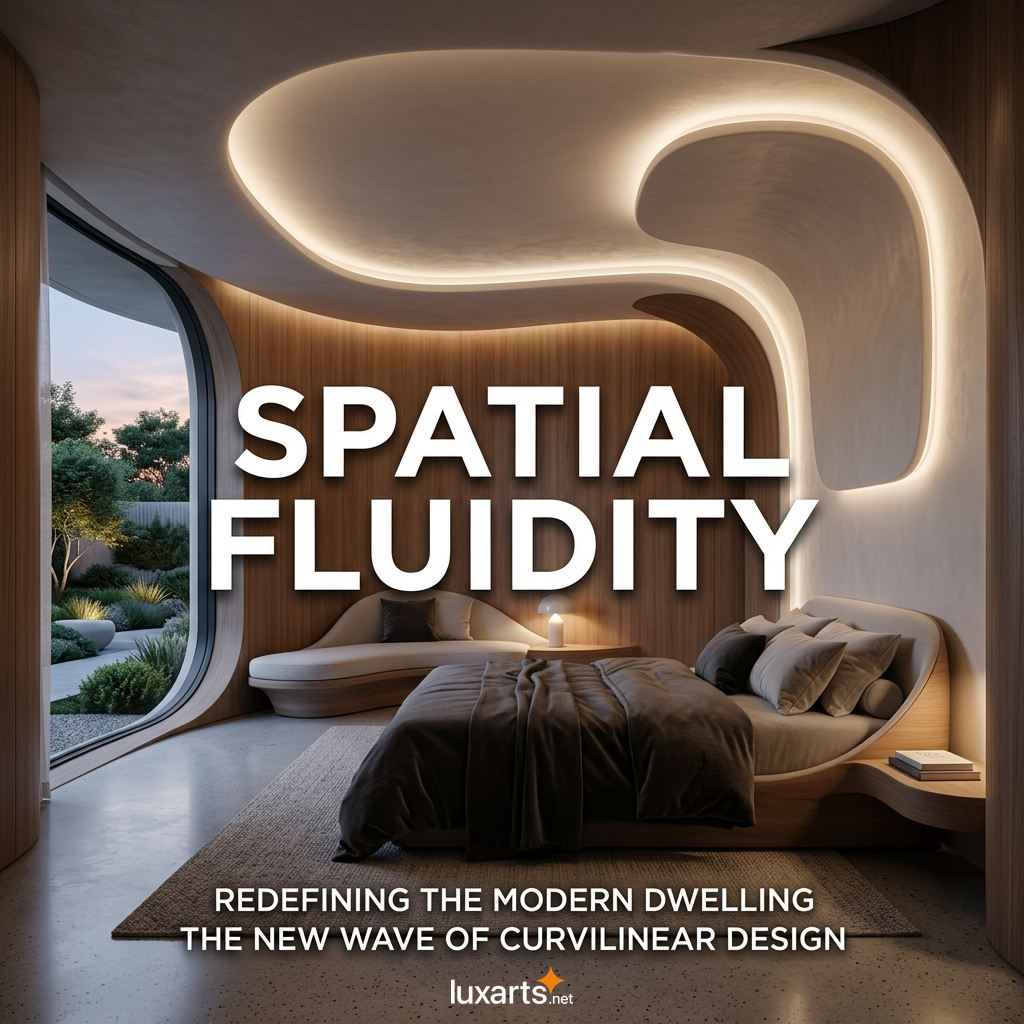
There is a quiet contradiction at the center of residential design that almost no one names directly: the room built for the least conscious, least controlled hours of human life is also the most rigidly engineered room in the house. Living rooms flex. Kitchens have been reinvented a dozen times over. But the bedroom — the one space where the body is meant to surrender — has remained, for nearly a century, a box. Four walls, ninety-degree corners, a door on one axis, a window on another. We call this restraint. It is, in fact, an inherited error.
The Static Box as an Inherited Structural Accident
The right-angled bedroom was never a psychological decision. It was a structural one. Load-bearing masonry, standardized timber framing, and the economics of drywall all favored orthogonal geometry because it was cheap to build and easy to stack. The bedroom did not become a box because rest requires enclosure — it became a box because concrete and lumber are easier to cut straight. Somewhere in the twentieth century, that construction convenience quietly rebranded itself as design orthodoxy, and several generations of architects inherited the rectangle without ever interrogating why it was there.
What makes this worth revisiting now, in 2026, is that the constraints that produced the box no longer exist. Parametric fabrication, biomaterial composites, and adaptive polymers have made curvilinear and irregular geometry no more expensive to produce than a straight wall. The box has outlived its own justification, and yet it persists — largely because no one has asked what the bedroom would look like if its geometry were derived from the nervous system instead of the lumber yard.
Corners as Cognitive Friction
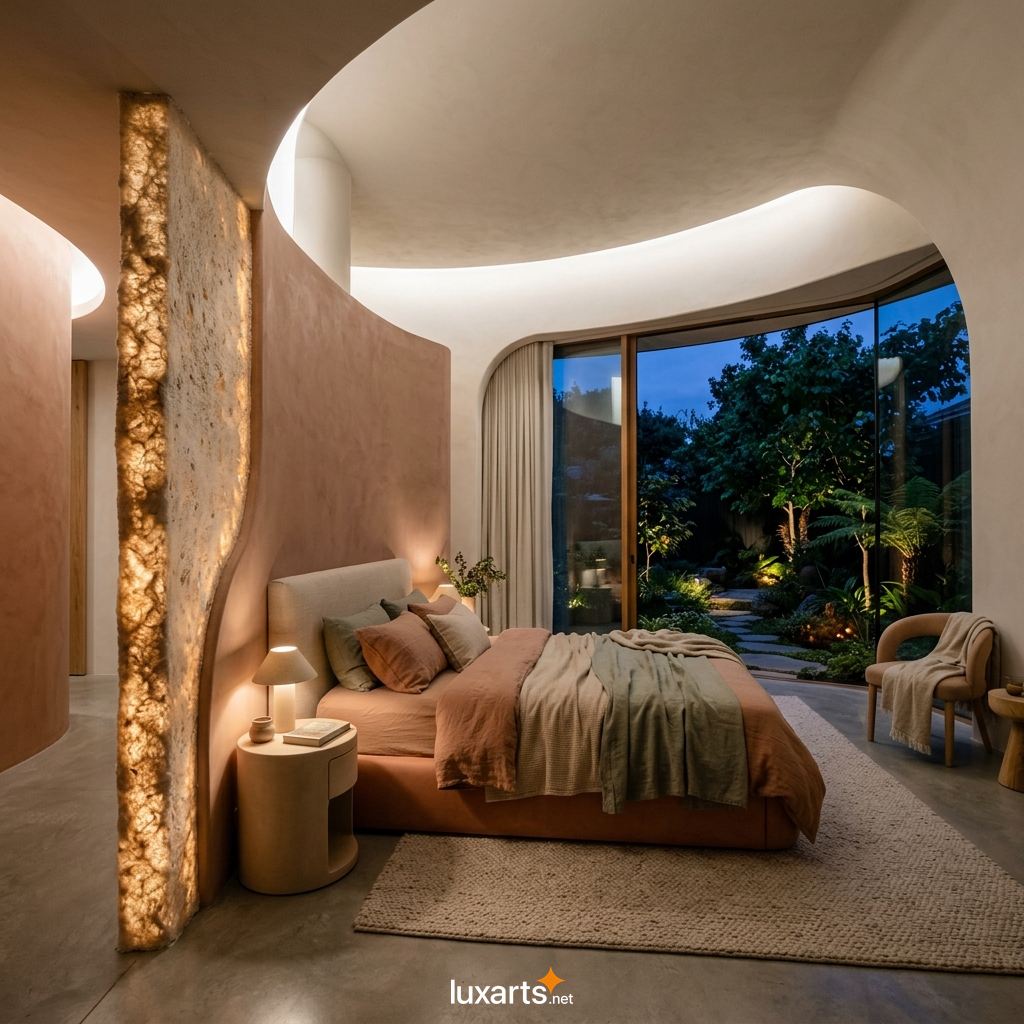
Neuro-architecture research over the past decade has been consistent on one point that the residential design world has been slow to absorb: the human visual cortex processes sharp, converging angles as points of unresolved tension. A ninety-degree corner is not neutral. It is a location the eye returns to, an unconscious edge the mind keeps checking, even in a room designed for sleep. This is not a claim about aesthetics — it is a claim about cognitive load. A bedroom governed by hard corners is, structurally, a room that keeps low-grade vigilance switched on, even as the occupant tells themselves they are relaxing.
Fluidity, in this context, is not a stylistic preference for curves. It is a direct intervention in spatial psychology — the deliberate removal of geometry that the nervous system reads as unresolved.
There is a second, quieter cost to the corner that architects rarely price into a floor plan: acoustic behavior. A right-angled room reflects sound back on itself, doubling low frequencies at the intersection of two perpendicular planes and producing standing waves that the ear cannot consciously identify but the body registers as friction. Curved and faceted geometry disperses those same frequencies instead of concentrating them, which is part of why a fluid bedroom can feel quieter than an acoustically treated box even before any absorptive material is introduced. Silence, in other words, is partly a geometric property, not only a material one.
Fluidity as a Structural Language, Not a Decorative Gesture
To take fluidity seriously as a structural language rather than a decorative flourish requires abandoning the idea that a curved wall is simply a straight wall bent for effect. The curvature has to originate from something — from airflow modeling, from acoustic dispersion, from the path the body actually takes moving from bed to threshold at three in the morning. This is where 2026’s material palette earns its place in the conversation.
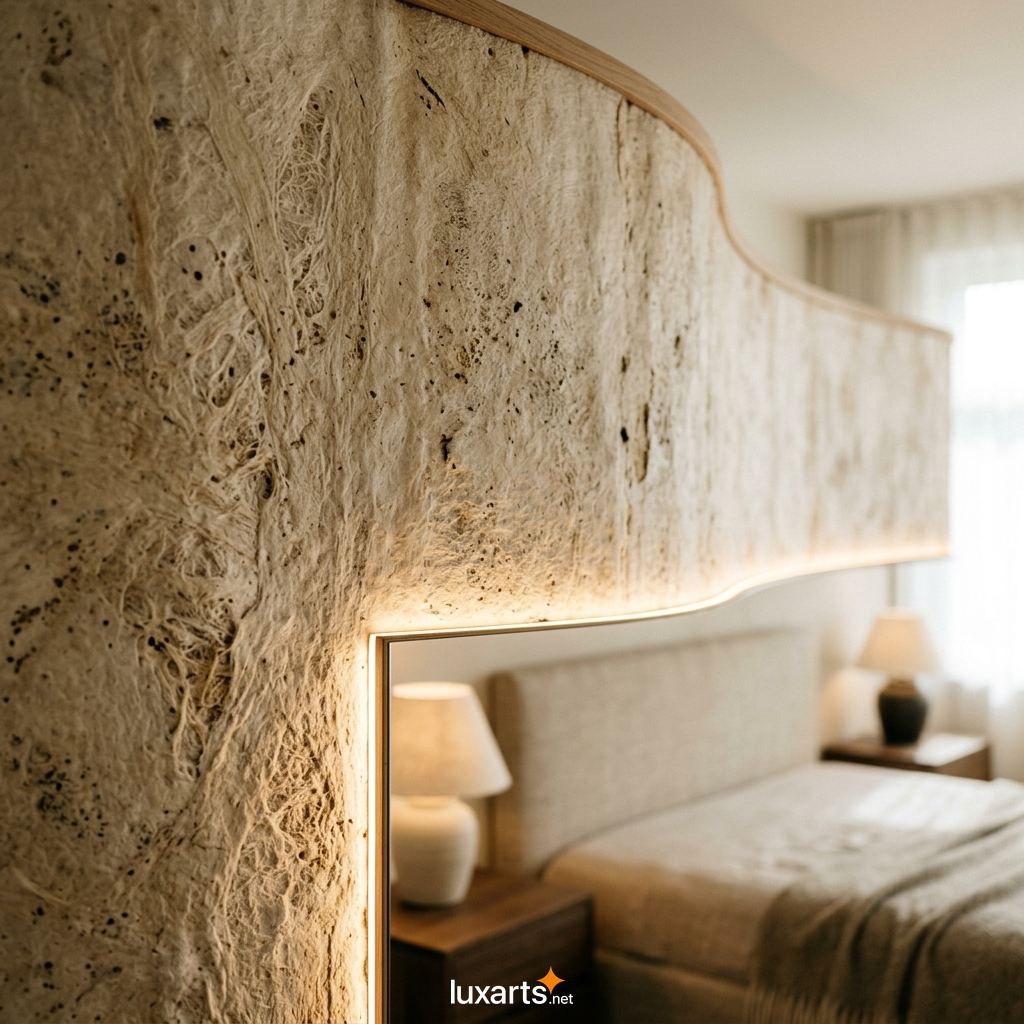
Mycelium-based composites, now structurally viable at partition scale, allow load-bearing curvature without the seams and joints that force a wall back toward straightness. Phase-change gypsum panels — capable of shifting thermal mass in response to ambient temperature — behave differently in a curved plane than a flat one, distributing heat along a gradient rather than radiating it from a single flat face. Combined with ambient intelligence systems that read occupancy, circadian phase, and even heart rate variability, the room stops being a fixed container and becomes a responsive volume — one that can narrow toward the bed at the hour of sleep and widen toward the dressing threshold at the hour of departure.
The Kinetic Partition
The most technically demanding expression of this shift is the kinetic partition: a non-orthogonal dividing element, typically track-mounted along a curved ceiling channel rather than a straight rail, that reconfigures the room’s usable geometry without relying on the hinge-and-frame logic of a conventional door. Unlike a sliding panel, which merely relocates a flat plane, a kinetic partition built from adaptive polymer laminates can change its own curvature — flattening to enclose a work alcove during the day, then relaxing into a shallow arc that opens the sleeping zone toward the window at night. The mechanism matters less than the outcome: the wall is no longer a boundary the occupant negotiates around. It is a boundary that negotiates itself.
As explored in far greater depth at The Architecture of Slumber: Redefining the Private Sanctuary for 2026, this kind of structural responsiveness is not a gadget layered onto an otherwise conventional room — it is the argument that the private sanctuary of 2026 has to be understood as a condition rather than a container, and that spatial fluidity is the mechanism through which that condition becomes physically real.
Transitional Zones: Dissolving the Boundary Between Rest and Function
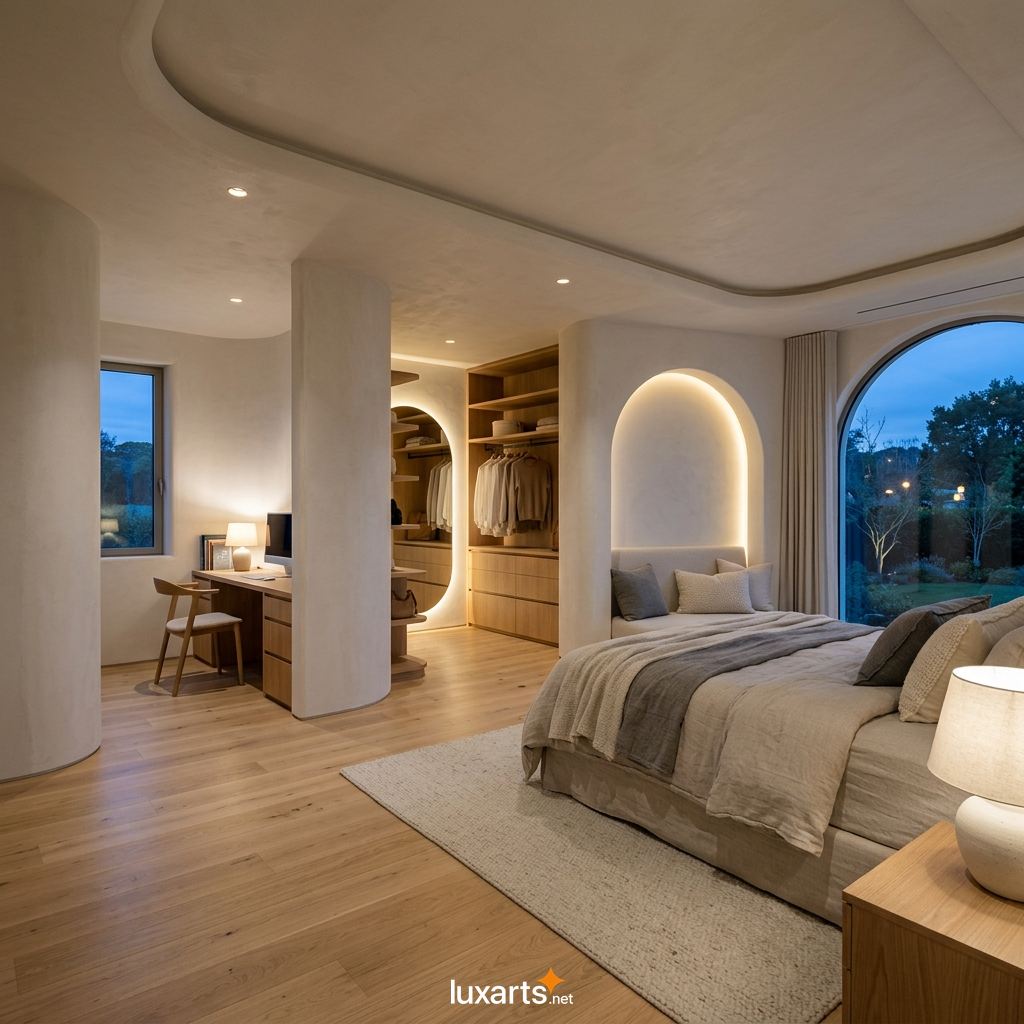
Once the corner is gone, the second inherited fiction starts to fall apart on its own: the idea that a bedroom, a closet, and a home office are three separate programs requiring three separate rooms. That division was never functional necessity either — it was a byproduct of the same orthogonal planning logic, where each activity was assigned its own box because boxes are how spreadsheets and floor plans like to organize square footage.
A fluid plan treats these instead as transitional zones — gradients of function rather than partitioned rooms. The dressing threshold might be defined not by a wall but by a change in floor material, a shift in ceiling height, or a subtle drop in ambient light intensity triggered automatically as the occupant crosses it. The work alcove might exist only during working hours, its boundary drawn by a partial curved screen that retracts into the ceiling cavity once the ambient intelligence system detects the transition into evening circadian phase. Nothing here is left to the occupant’s memory of a schedule — the architecture itself tracks the transition and reshapes accordingly.
Regenerative Materials as Spatial Punctuation
This kind of responsiveness only works if the materials used to define each zone are legible without being loud. Porous stone composites and unglazed ceramics, increasingly sourced through regenerative design supply chains that return byproduct material to the manufacturing loop rather than the landfill, give each transitional zone a distinct tactile signature the body can register without conscious attention — cooler and more porous underfoot near the dressing threshold, warmer and more monolithic near the bed platform itself. The senses, not the eyes, end up doing most of the work of orientation. That is a deliberate inversion of how boxed bedrooms have always operated, where orientation was a matter of visual memory — this door, that wall — rather than atmospheric cognition.
Sculptural Mass and the Psychology of Enclosure
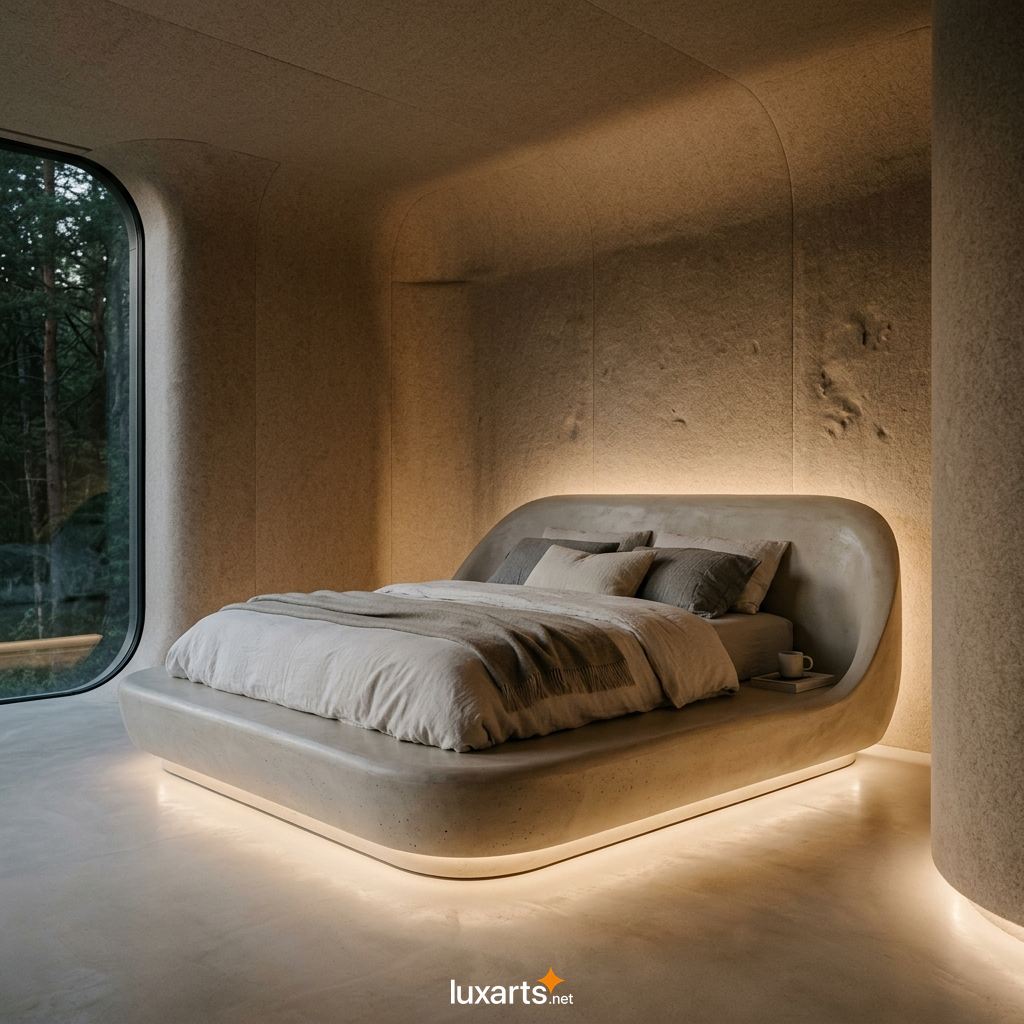
None of this argues for dissolving enclosure altogether — an entirely open plan produces its own psychological cost, a low-grade exposure that undermines rest just as effectively as an over-boxed room does. The goal of fluid geometry is not to remove mass but to redistribute it. A monolithic bed platform, carved or cast as a single curved volume rather than assembled from framed components, gives the room a gravitational center without relying on walls to define containment. Porous acoustic surfaces absorb rather than reflect the low ambient frequencies of a building’s mechanical systems, producing a quality of quiet that reads as atmospheric rather than merely silent — a subliminal cue of enclosure that the nervous system registers even when the sightlines around the bed remain relatively open.
This is the actual technical achievement of spatial fluidity: it produces containment through mass, material, and gradient rather than through walls and corners. The occupant still feels held. They simply no longer feel boxed.
There is also a temporal dimension to sculptural mass that flat, framed construction cannot replicate. A monolithic form cast or carved as a single volume ages along its surface rather than at its joints — it develops patina evenly, the way stone or clay does, instead of failing first at the seams where two flat panels meet. In a room designed around the body’s most vulnerable hours, that durability is not incidental. A bed platform that will not crack at a corner, in a room that has none, reinforces the same subliminal message the geometry is already sending: nothing here is waiting to come apart.
Where This Goes Next
The next stage of this trajectory is not more curvature for its own sake. It is the gradual disappearance of the bedroom as a fixed architectural program altogether. Within the decade, expect the private sanctuary to be defined less by square footage allocated on a floor plan and more by a temporary spatial state — a configuration that ambient intelligence assembles from a larger, undivided volume for the hours it is needed, then dissolves once the occupant moves on to the next transitional zone. The box will not be renovated out of existence. It will simply stop being built, because the geometry it was solving for was never really ours to begin with.
NOTE: All images in this post are AI-generated and intended solely for inspiration. These are not real products available for sale, and we do not operate any online store or website for purchases.