
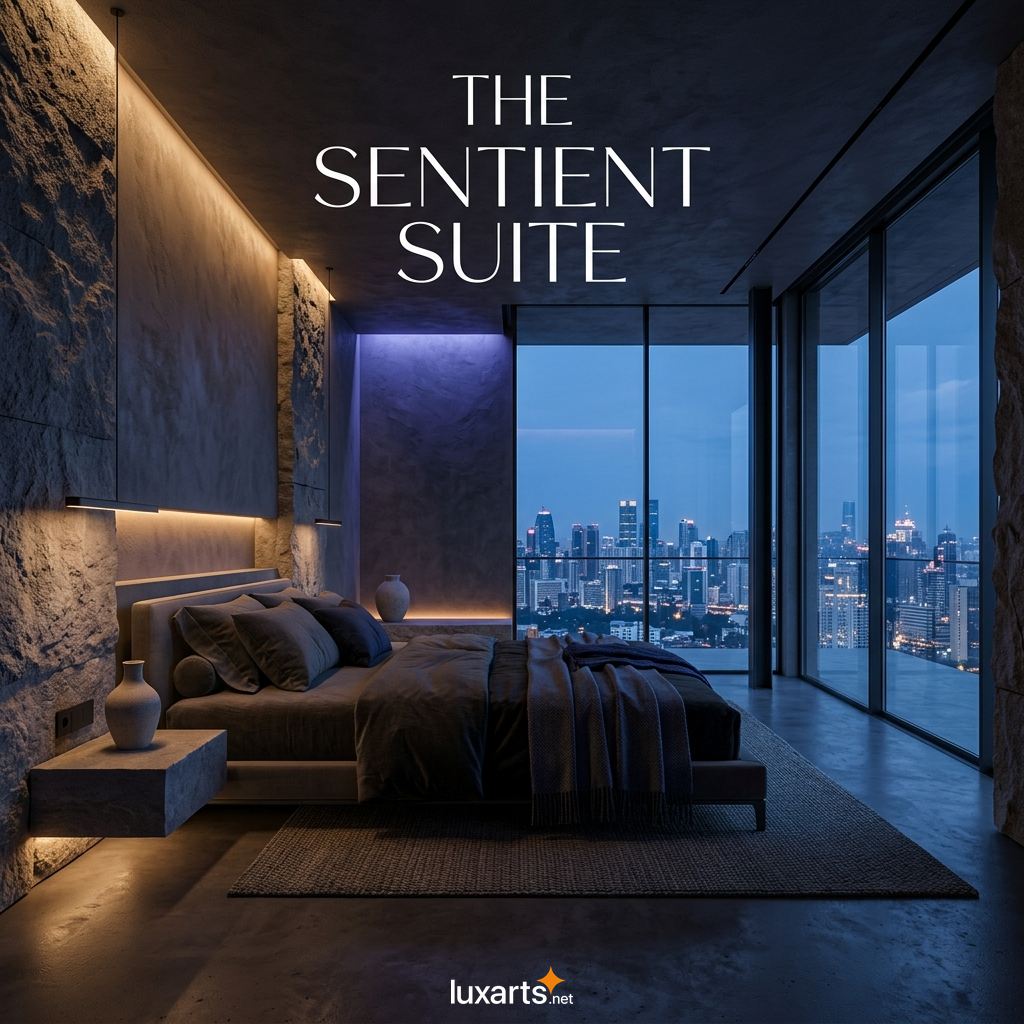
There is a particular failure embedded in the last decade of residential technology: the assumption that intelligence must announce itself. A speaker with a glowing ring. A panel demanding a tap. A thermostat that blinks awake when you walk past it. Every one of these objects performs its intelligence for you, and in doing so, it violates the first principle of a bedroom — that it should ask nothing of the occupant. The sanctuary becomes a control panel. The nervous system, already taxed by a waking day of notifications, is asked to negotiate with its own walls.
The Sentient Suite rejects this premise entirely. It is not a room with technology inside it. It is a room that behaves as though the technology were never separate from the architecture to begin with — walls that shift opacity without a switch, spectral light that recalibrates without a prompt, acoustic fields that dampen without a dial. The intelligence is present, but it has withdrawn from view. What remains is a space that responds to the body the way a forest canopy responds to wind: continuously, silently, without a single moment of felt operation.
The Philosophy of Ambient Intelligence
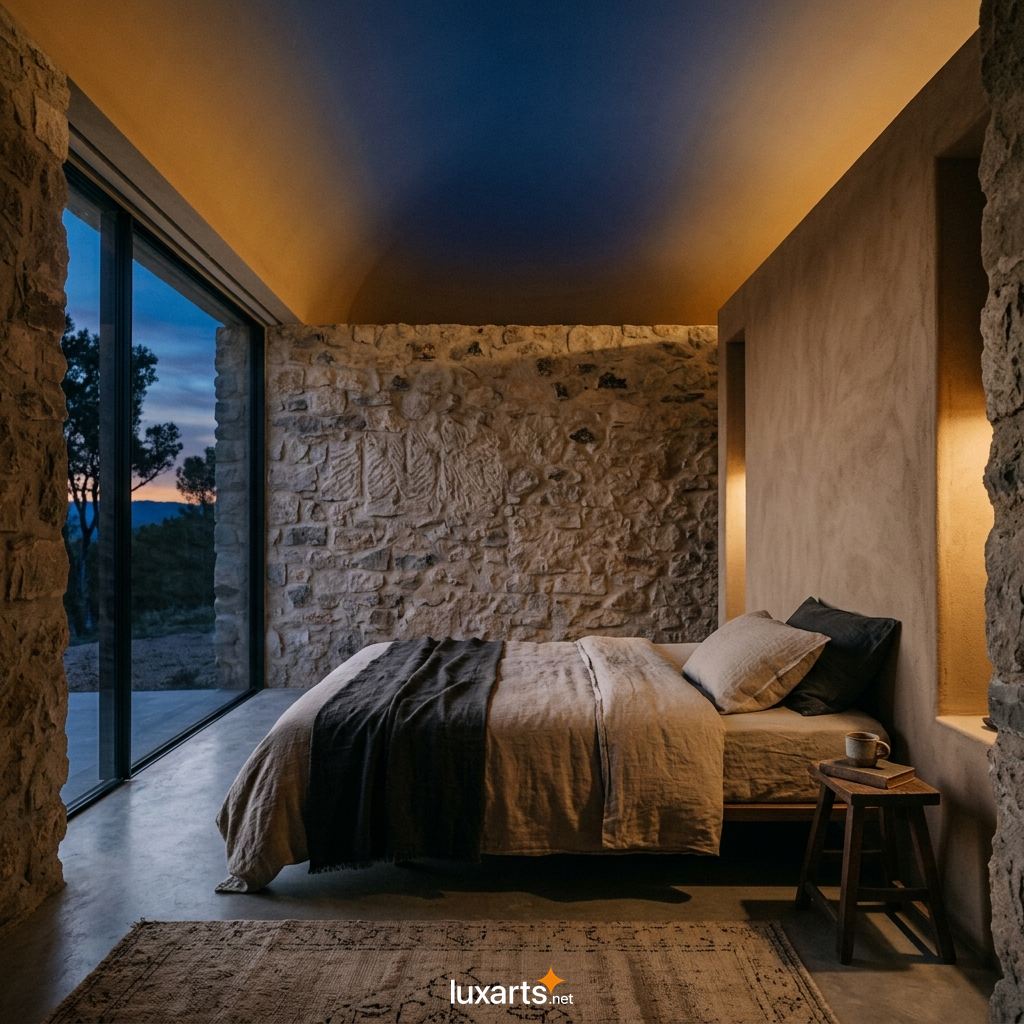
Ambient intelligence, properly understood, is not automation. Automation executes a rule: if motion, then light. Ambient intelligence practices something closer to symbiosis — a continuous, low-grade negotiation between biological state and architectural response, so gradual that no single moment of change is ever consciously registered. The occupant does not experience “the lights dimming.” They experience, retrospectively, having been in darkness, without ever having witnessed the transition.
This distinction matters enormously to spatial psychology. Perceived control is a known variable in stress physiology — a person who must operate their environment remains, at some low cortisol-adjacent level, in a state of vigilance. A person whose environment operates around them, correctly, without demand, is permitted a deeper form of surrender. The architecture assumes the cognitive burden that the device economy previously outsourced to the user. This is the actual philosophical wager of the Sentient Suite: that true luxury in 2026 is not the multiplication of controllable features, but their complete disappearance into subliminal adaptation.
As analyzed in The Architecture of Slumber, the shift from passive to sentient spaces is not merely aesthetic; it is a physiological necessity. The pillar piece establishes that contemporary sleep architecture must contend with a nervous system in near-permanent low-grade activation — a condition no amount of thread-count or blackout drapery can resolve on its own. What that argument implies, and what this piece makes explicit, is that only a room capable of reading and answering biological signal in real time can meet that physiological demand. Static luxury, however refined, is architecturally inert against a dynamic problem.

Architectural Choreography as Discipline
The term “choreography” is used deliberately over “automation” because choreography implies sequence, timing, and relational movement between elements — precisely what distinguishes a Sentient Suite from a merely reactive one. A single sensor triggering a single output is a switch. A room in which circadian light temperature, wall porosity, subfloor thermal mass, and acoustic absorption all shift in coordinated relation to one another, staged against a biometric timeline unique to the sleeper, is choreography. The designer’s role shifts accordingly — from specifying fixed finishes to composing a temporal score that the architecture performs nightly, with variations keyed to the occupant’s actual physiological arc rather than a fixed clock.
Bio-Feedback Integration: The Room as Physiological Partner
The defining technical achievement of the Sentient Suite is the closed loop between biometric input and architectural output, executed without any wearable device breaching the skin or the visual field. Under-mattress piezoelectric arrays, capacitive wall sensors embedded beneath plaster, and millimeter-wave presence detection concealed within cornice work now provide continuous, contactless readings of heart rate variability, respiratory rate, and micro-movement — data streams precise enough to infer sleep stage transitions without a single strap, ring, or patch touching the body.
This data does not surface on a screen. It disappears directly into the building’s response systems. A rise in heart rate variability consistent with REM onset might trigger a further narrowing of acoustic transmission through the wall assembly. A respiratory pattern suggesting sleep-stage regression toward N1 might prompt a barely perceptible increase in ambient CO2 exchange through a mechanically ventilated, invisible wall cavity. None of this requires the occupant to have configured anything. The room has simply learned, over weeks, what this particular body does at 2:47 a.m., and it answers accordingly.
Spectral light tuning represents perhaps the most biologically consequential of these interventions. Rather than the blunt instrument of “warm versus cool” lighting scenes, suites at this tier now deploy tunable-phosphor and micro-LED arrays capable of shifting not merely color temperature but the actual spectral power distribution of ambient light — suppressing the specific 460-480nm wavelength band most implicated in melatonin suppression while preserving enough short-wavelength content to avoid the flat, deadening quality of pure amber light. The result is illumination that feels, subjectively, like late-afternoon light lingering past its hour — present, dimensional, and biologically permissive of sleep onset — rather than the theatrical orange wash of consumer “night mode” lighting.
Acoustic Dampening as a Living Membrane
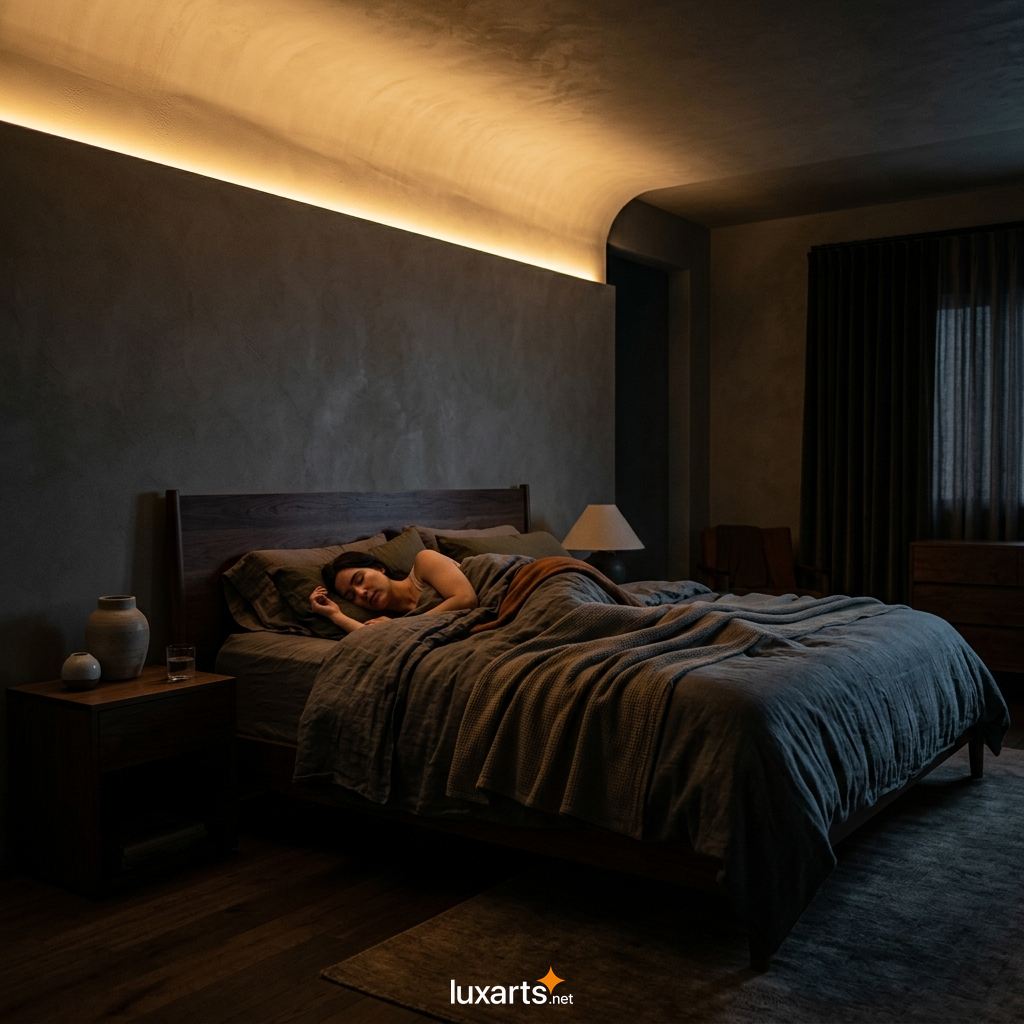
Silence, in a Sentient Suite, is not achieved through mass alone. Traditional acoustic design relies on static solutions — thickened walls, decoupled assemblies, dense insulation — that treat sound as a permanent adversary to be blocked at all hours equally. The sentient approach treats acoustic performance as a variable to be modulated in real time. Micro-actuated membrane panels, concealed entirely behind traditional plaster or textile wall finishes, can alter their internal cavity resonance within seconds, shifting the wall’s absorption coefficient across specific frequency bands in direct response to biometric sleep-stage data.
During lighter sleep stages, when auditory arousal thresholds are lowest, the wall assembly increases low-frequency absorption to suppress the transmission of building mechanical noise or distant traffic rumble. During deeper stages, when the sleeper is less acoustically vulnerable, the system can relax slightly, reducing energy load. The wall, in effect, breathes with the sleeper — porous in that word’s truest architectural sense: not passively permeable, but selectively, intelligently permeable, opening and closing its acoustic behavior in sympathy with a state it cannot see but can infer.
The Invisible Materiality: Building the Unseen System
None of this choreography is possible without a fundamental rethinking of material science — the physical substrate that must house sensing, actuation, and computation while presenting a surface indistinguishable from traditional monolithic plaster, stone, or timber. This is where 2026’s material research has made its most significant contribution to residential architecture, and where the discipline separates itself most clearly from the gadget economy it refuses to resemble.
Electrochromic and suspended-particle glazing, now available in curved and irregular formats suitable for bespoke window and partition geometries, allow entire glass walls to shift from full transparency to a soft, diffuse opacity within a two-second gradient — no motorized blinds, no visible mechanism, simply glass that thinks. Paired with thermochromic plaster composites capable of subtly altering surface reflectivity in response to embedded thermal actuators, the wall itself becomes a low-resolution display for warmth and coolness, communicated not through color but through tactile temperature shift — a form of ambient signaling read by the skin rather than the eye.
Structurally, this requires an entirely different approach to the wall assembly itself: no longer a single monolithic layer but a stratified system — a structural inner layer, a service cavity housing sensing and actuation hardware, and a finish layer engineered specifically for signal transparency, whether acoustic, thermal, or electromagnetic. The architect’s specification document now resembles something closer to a systems engineer’s schematic than a traditional finish schedule, though the finished surface reveals none of that complexity. This is the discipline’s central paradox, and its central achievement: the more sophisticated the embedded system, the more the finished room must resist any visual evidence of it.
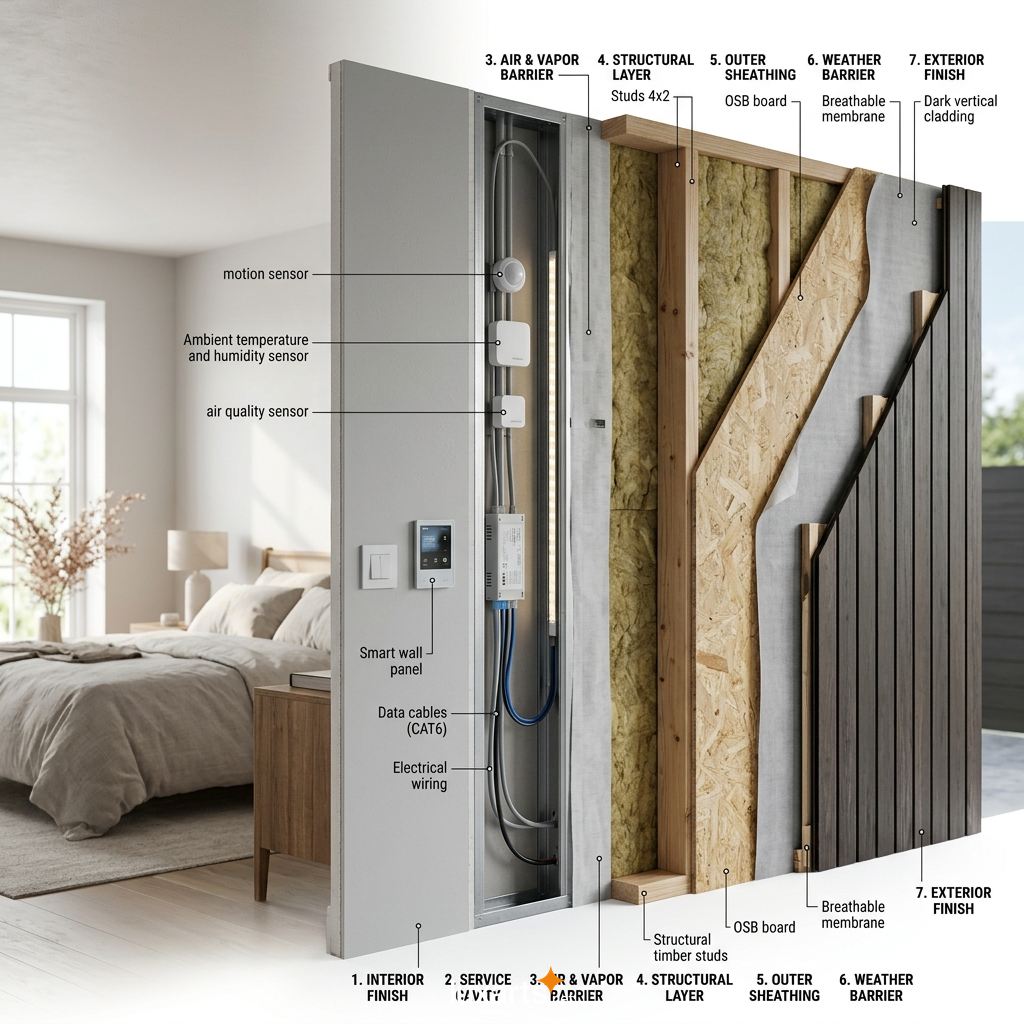
As explored further in The Architecture of Slumber, material selection for the private sanctuary can no longer be evaluated on tactile and visual criteria alone. Every finish now carries a secondary specification — its signal transparency, its capacity to house or transmit the sensing infrastructure beneath it — meaning the architect’s material palette has effectively doubled in complexity even as the visible palette has, by design, simplified toward monolithic restraint. A single slab of book-matched stone veneer might now conceal three distinct actuation zones behind it, each invisible, each essential.
The Question of Consent and Data Intimacy
A room this attentive to the body raises a question the smart-home industry never seriously confronted: what does it mean for architecture itself to hold biometric data? Unlike a wearable, which the occupant can remove, a Sentient Suite’s sensing infrastructure is inseparable from tenancy. The ethical architecture of these systems — local edge processing rather than cloud transmission, no persistent identity storage, full physical override of every subsystem — is no longer a technical footnote but a design requirement equal in weight to structural load calculations. A suite that reads the body but cannot be made to forget it is not luxury. It is surveillance wearing the costume of hospitality.

There is a version of the future in which the bedroom becomes the most biologically literate room in the building — more responsive to the sleeping body than any prior structure in the history of shelter, and yet legible to the eye as nothing more than stone, plaster, and light. The next frontier will not be more sensors or finer-grained data. It will be architecture’s slow absorption of biological science into its material vocabulary, until the distinction between a building material and a physiological instrument simply ceases to be a meaningful one.
NOTE: All images in this post are AI-generated and intended solely for inspiration. These are not real products available for sale, and we do not operate any online store or website for purchases.