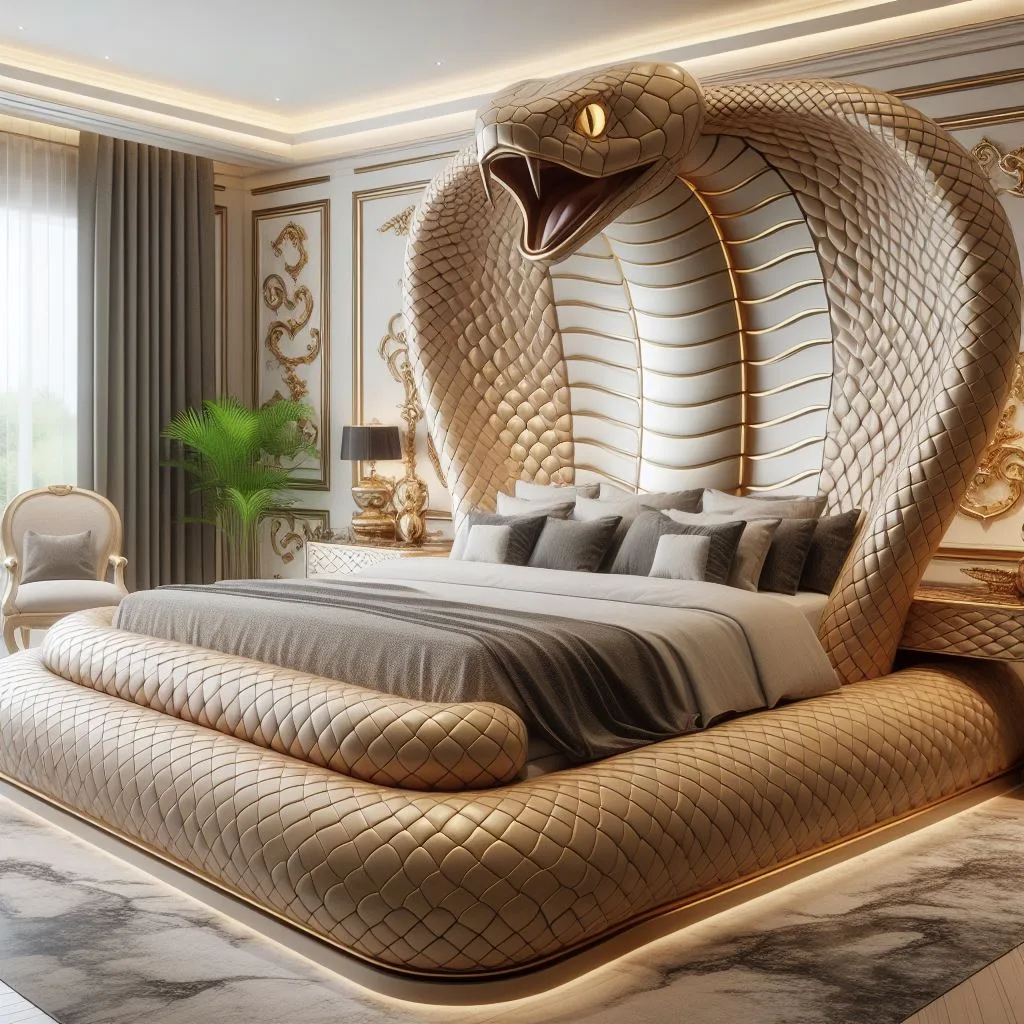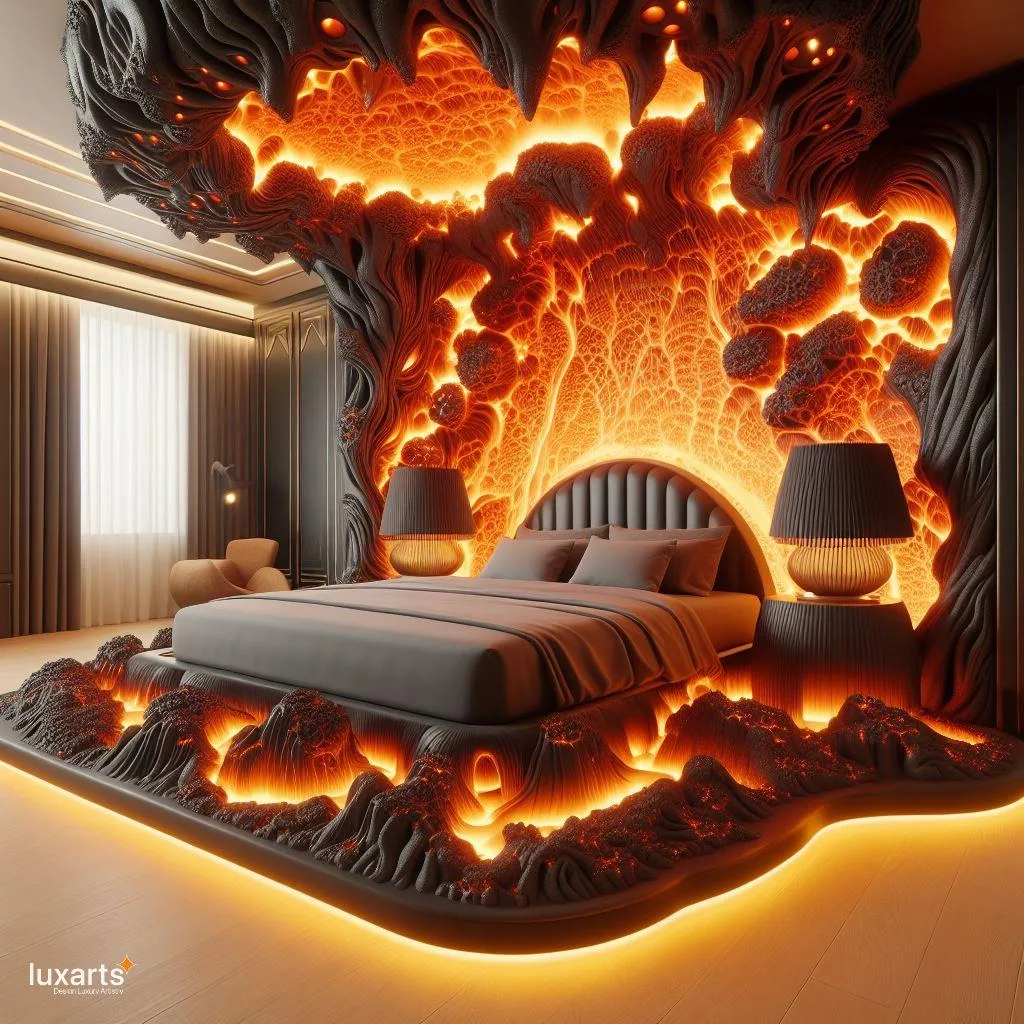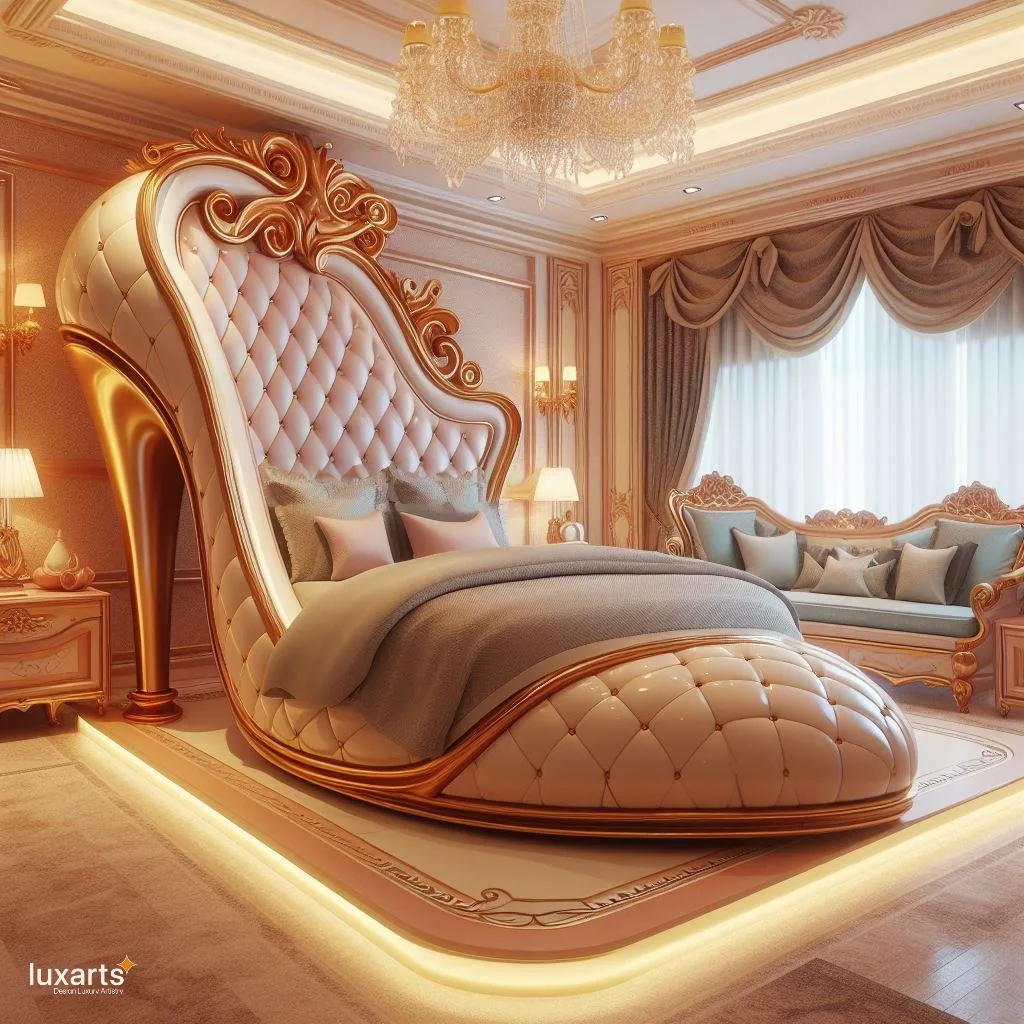

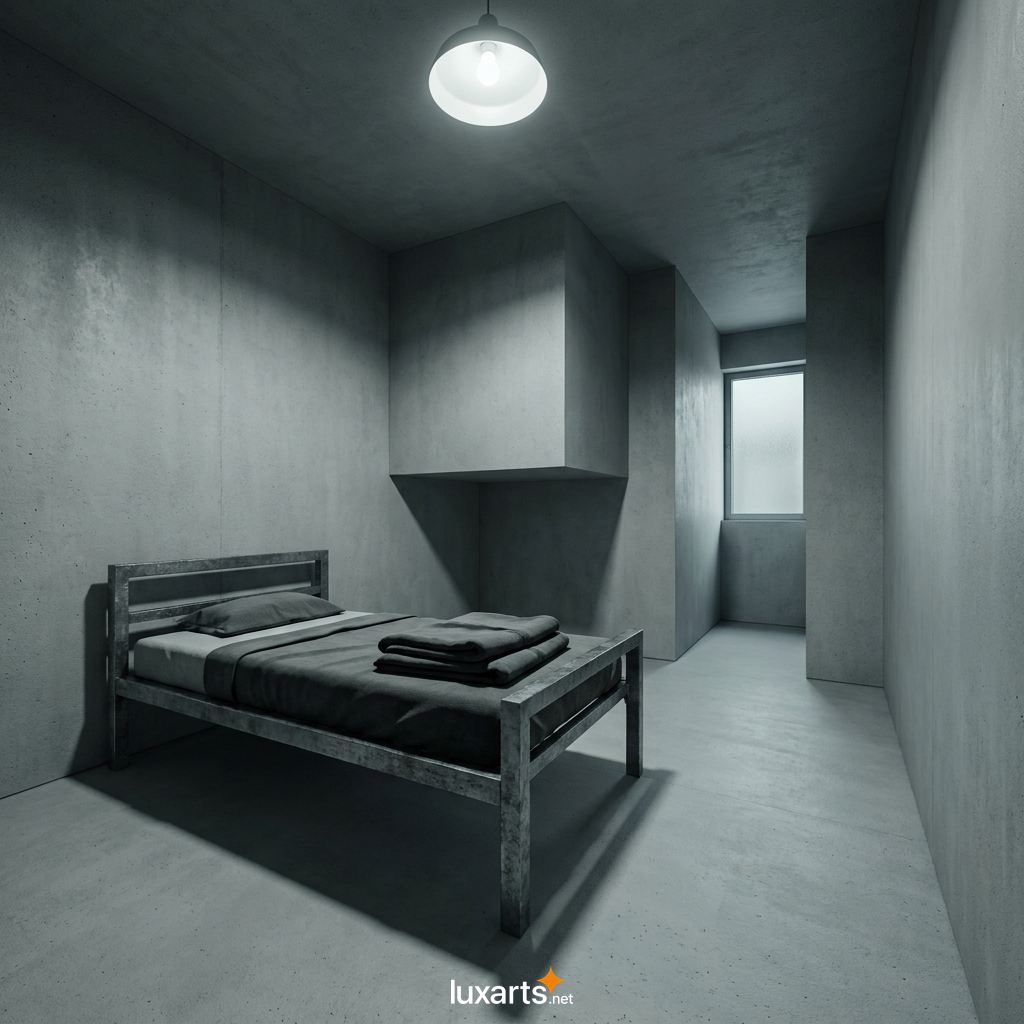
A bed. Four square walls. A door that closes each night like a reluctant ritual. This is not a bedroom — it is a storage unit for the human body, engineered by people who never once asked what actually happens to a brain when it slips into darkness.
Interior design, for most of its modern history, has committed a systemic error. We decorate bedrooms as though they were miniature living rooms — places to display taste, to house expensive furniture, to be photographed for a magazine spread. But a bedroom is not a stage. It is an operating theatre, where the central nervous system repairs itself, alone, every single night. And we have built some of the worst operating theatres in the history of human architecture.
This is a failure of architectural empathy. We design for the eye, not for the limbic system. We optimize for the moment someone first walks into a room, not for the eight hours that follow, when the body lies motionless and the brain quietly performs the hardest labor of its day: consolidating memory, clearing neurotoxic waste, rebuilding the immune system.
I. The Manifesto: The Crisis of the “Sleeping Box”
2026 is not an ordinary year in the psychological history of our species. It is the year the boundary between labor and rest dissolved entirely. The phone no longer lives on the desk — it lives on the pillow. Notifications no longer stop at six in the evening — they follow us into the edge of sleep itself. Against this backdrop of relentless connectivity, the home — and the bedroom specifically — has become the last fortress of human sanity.
But that fortress is under siege from within its own structure. Most modern “sleeping boxes” — whether clad in Calacatta marble or solid walnut — still obey an outdated design logic: the geometry of storage, not the geometry of recovery. Wardrobes are given priority over natural light. Vanity stations claim better real estate than ceiling proportion. This is a serious confusion between the function of holding things and the function of healing people.
What we intend to establish in this piece — and across the research series that follows — is an irreversible paradigm shift: the move away from Interior Decoration and into the territory of Architectural Biology. The room can no longer be a passive shell that contains objects. It must become a living partner, synchronized with the circadian rhythm of the person who inhabits it.
This is not a fleeting aesthetic trend. It is a philosophical restructuring of what a home is for. Architects and developers still clinging to old decorative thinking will soon discover that their clients — people who can already afford almost anything — now crave exactly one thing money has rarely bought them: sleep that actually restores.
Consider the arithmetic of a single life. A person who lives to eighty spends roughly twenty-seven of those years asleep — nearly a third of an existence surrendered to a room most of us never think to design with any rigor at all. We commission a kitchen renovation with the seriousness of a surgical consult. We hire consultants for a home theater’s acoustic curve. And yet the room responsible for a third of our lifespan is handed a headboard, a rug, and a scented candle, and called finished. That imbalance is the true scandal at the center of contemporary residential design.
II. The Neuroscience of Space: Why Geometry Determines Recovery
The Concept of Spatial Trauma
There is a phenomenon in architectural psychology known as spatial trauma — a low-grade, sub-perceptual stress state triggered by flawed geometric decisions in a living environment. A sharp corner aimed directly at the head of the bed. A jarring ratio between bright and dim zones that forces the pupils into constant readjustment. An absence of visual harmony between surfaces — one cold expanse of wall facing a window that glares.
The human brain, whether asleep or awake, never fully stops scanning its surroundings for threat. This is an evolutionary inheritance hundreds of thousands of years old, and no velvet curtain or Murano chandelier erases it. When a room’s geometry produces incoherent signals — an aggressive angle, an undefined pocket of darkness behind the sleeper, a ceiling pressing down too low — the limbic system quietly triggers a low-level vigilance response. Cortisol leaks out in small, steady doses, enough to fracture deep sleep without ever announcing itself as the cause.
This is why so many clients describe an expensively finished bedroom as, inexplicably, “not quite right.” The unease is real, and it is measurable, even when its source is invisible to an untrained eye. A designer who cannot read a floor plan for its neurological consequences — who cannot look at a ceiling height and predict the stress response it will provoke at three in the morning — is not yet equipped to design a bedroom at all, regardless of how refined their material palette might be.
The Safe Cave Against the Open Vista
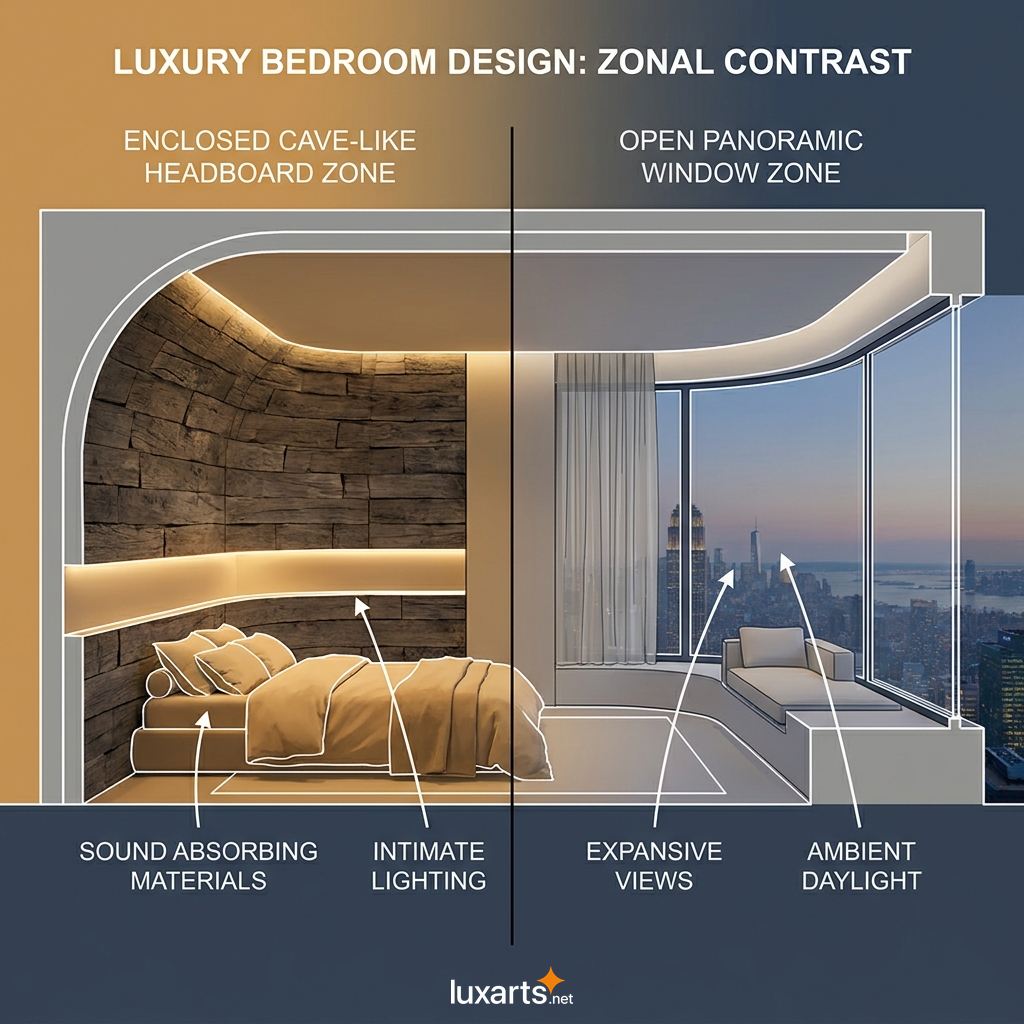
Neuro-architecture is built on an ancient paradox: humans need enclosure, the way a primitive cave offered protection, while simultaneously craving an open vista, a modern symbol of power and freedom. A ceiling that is too high leaves the limbic system feeling exposed, unprotected. A space that is too tight, too low, triggers the sensation of confinement.
The answer is not choosing one over the other — it is zoning by neurological function. The headboard zone demands high enclosure density: solid walls, low light, dense materials that read as cave-like. The zone the eyes meet upon waking, by contrast, demands an open vista: natural light, a view toward greenery, or at minimum an unobstructed visual field. This is the exact principle serious 2026 designers are now required to master.
The Circadian Sync
If geometry governs the sense of safety, light governs brain chemistry. The principle of circadian sync in architecture rests on a simple physiological mechanism that is routinely ignored: the pineal gland only secretes melatonin once the blue-light wavelength in the environment drops below a specific threshold. A fixed lighting system, one that never shifts color temperature across the day, is an act of biological sabotage — no matter how refined the LED fixtures installed to deliver it.
Contemporary architectural psychology insists that light should never be treated as a fixture, but as medicine on a schedule. Mornings call for high intensity, cool-leaning blue light to suppress residual melatonin. Evenings call for a gradual dimming into a warm amber spectrum, mimicking a natural sunset — the exact experience our ancestors lived every day for millions of years before the incandescent bulb rewired the ritual.
The core takeaway of this chapter: design is not aesthetics. Design is neuroscience. A beautiful room with flawed geometry and lighting is still a harmful room — the harm is simply disguised beneath an expensive finish.
III. The Invisible Infrastructure: Ambient Intelligence & The “Living” Room
Beyond “Smart Home” Gimmicks
It has to be said plainly: most of what the market has called “smart home” over the past decade is a technological farce. Voice-controlled bulbs. App-connected door locks. Curtains that open on a rigid schedule. This is not intelligence — it is remote control repackaged under a shinier name. Worse, these devices frequently add a fresh layer of cognitive load: a password to remember, an app to open, a Wi-Fi handshake to wait through before the room responds to something as simple as turning off a light.
A serious 2026 developer is no longer seduced by the sheer number of connected devices. They ask a harder question: does this technology genuinely reduce cognitive burden, or does it simply add another layer of complexity to a life that is already overloaded?
The 2026 Vision of Ambient Intelligence
The answer lies in an entirely different design philosophy: ambient intelligence — a room that senses and responds without a screen, without a button, and, most critically, without a camera. Hidden biometric sensors, embedded in the mattress and the wall itself rather than mounted as visible surveillance, track heart rate, skin temperature, and respiratory frequency in real time.
Picture a wall carrying an ethereal, almost immaterial quality, its opacity shifting gradually in response to the stress level read from the sleeper’s heart rate — thickening, becoming more enclosing, as cortisol rises, and softening open again as the body relaxes. Picture an acoustic-absorption system embedded in the wall that adjusts its own micro-density, increasing sound isolation during the exact hours biometric data shows the sleeper is in their most sensitive stage of deep sleep. This is no longer science fiction — it is the point where intelligent materials science and sensor-driven architecture are converging.
The design challenge here is restraint, not capability. It would be trivial to load a room with sensors and let it announce every reading on a dashboard somewhere. The far harder task — and the one that actually separates ambient intelligence from surveillance dressed up as wellness — is building a system that acts and then stays quiet about it. The homeowner should never have to check whether the room did its job. They should simply wake up having slept better, with no memory of the room having done anything at all.
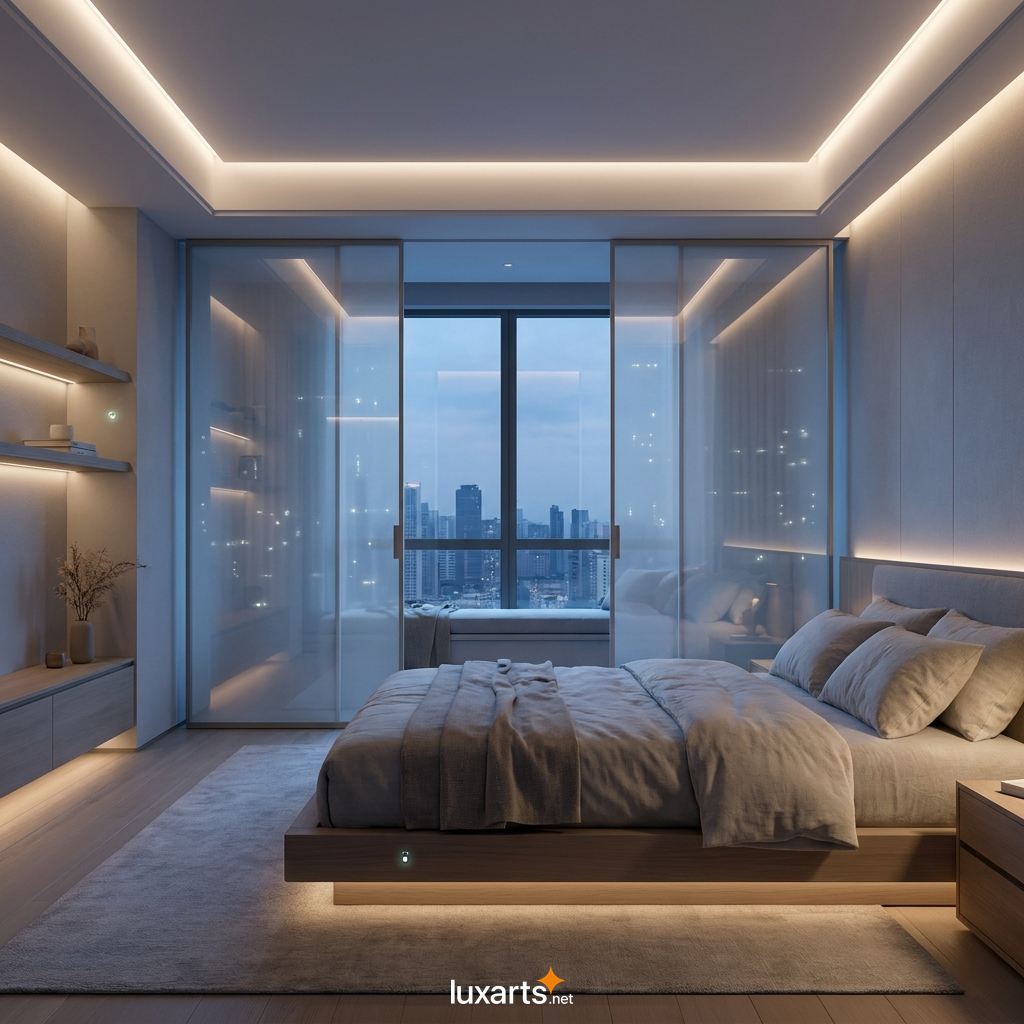
The Tech-Silent Room
Here is the central paradox of 2026: the most advanced technology is the technology that disappears entirely. A genuinely luxurious bedroom no longer parades a touchscreen mounted on the wall, no longer blinks with a smart speaker’s LED ring. All of the intelligence is embedded into the material, into the structure, into the architectural DNA of the room itself — invisible to the naked eye, yet present the instant it is needed.
We have dedicated a full study to this subject, examining how hidden sensor systems can shape an entire nocturnal environment without a single visible interface. The Sentient Suite: Invisible AI Systems That Sculpt Your Nocturnal Environment explores the technical architecture behind this philosophy of “silent technology” in far greater depth.
IV. Materiality as Therapy: The Sensory Revolution
The Tactile Imperative
Synthetic plastic. Low-grade MDF wrapped in faux-wood veneer. Industrially woven polyester. These are cold, inert surfaces — they carry no memory, no breath — and they represent the quiet death of authentic luxury. Human skin, pressed against a synthetic surface for eight uninterrupted hours, receives no biological feedback signal whatsoever. No natural heat exchange. No moisture permeation. No trace of “life” in the material itself.
This is precisely what we call the tactile imperative: in a space designed for neurological recovery, every surface that touches the body must carry biological authenticity, must “breathe” in rhythm with the room. True luxury in 2026 is no longer measured by the price per square foot of marble — it is measured by the biological honesty of every surface it contains.
Bio-Luxe Materials
We are entering the most significant transformation architectural materials science has seen in decades. Mycelium panels — grown, not manufactured, from fungal networks cultivated inside a defining mold — are redefining what sustainable luxury even means. Their organic texture is genuinely unrepeatable, their acoustic absorption is exceptional, and their ecological story is one no synthetic stone could ever match.
Hempcrete finishes — a composite of hemp fiber and lime — bring natural humidity regulation to a room, keeping its microclimate stable year-round without a single mechanical dehumidifier. Organic textiles woven from hemp fiber, unbleached linen, or organically raised mulberry silk complete a trio of core materials in this philosophy — where every surface literally breathes, exchanging moisture and warmth with the body resting on it through the length of the night.
None of this should be mistaken for rustic austerity. A mycelium panel, properly finished, can carry a depth of tone and a tactile richness that outperforms lacquered stone under the same lighting. The point is not to sacrifice opulence for sustainability — it is to recognize that, by 2026, the two have become the same requirement. A material that cannot regulate humidity, cannot exchange warmth with skin, cannot age with any grace, no longer qualifies as luxurious, no matter its price tag or provenance.

Biophilic Integration Within the Architecture
Placing a single potted pothos in the corner of a room is not biophilic integration — it is a superficial decorative gesture, borrowing the language of ecology without understanding its substance. Genuine biophilic integration demands vertical ecosystems built as part of a room’s load-bearing structure, not a piece of furniture that can simply be moved out of the way.
Hydroponic air-purifying walls, integrated from the earliest phase of structural design, function as the living lungs of a room — continuously exchanging CO2 and residual volatile organic compounds released by furnishing materials, while maintaining a stable humidity microclimate across all four seasons. This is not “adding a touch of green.” This is redesigning the respiratory system of the living space itself.
We examine the full methodology behind constructing these vertical ecosystems in Biophilic Bedchambers: Integrating Living Ecosystems, and go deeper into organic textile application in Beyond Minimalism: Bio-Luxe Textiles.
V. Reclaiming the Sanctuary: A Spatial Anatomy
Breaking the Four Walls
The idea of the bedroom as a sealed box, fully separated from the rest of the house by a single door and four perpendicular walls, is a legacy of twentieth-century industrial architecture — an era when space was divided along rigid functional lines to optimize mass construction efficiency. 2026 demands a different mindset entirely: spatial fluidity.
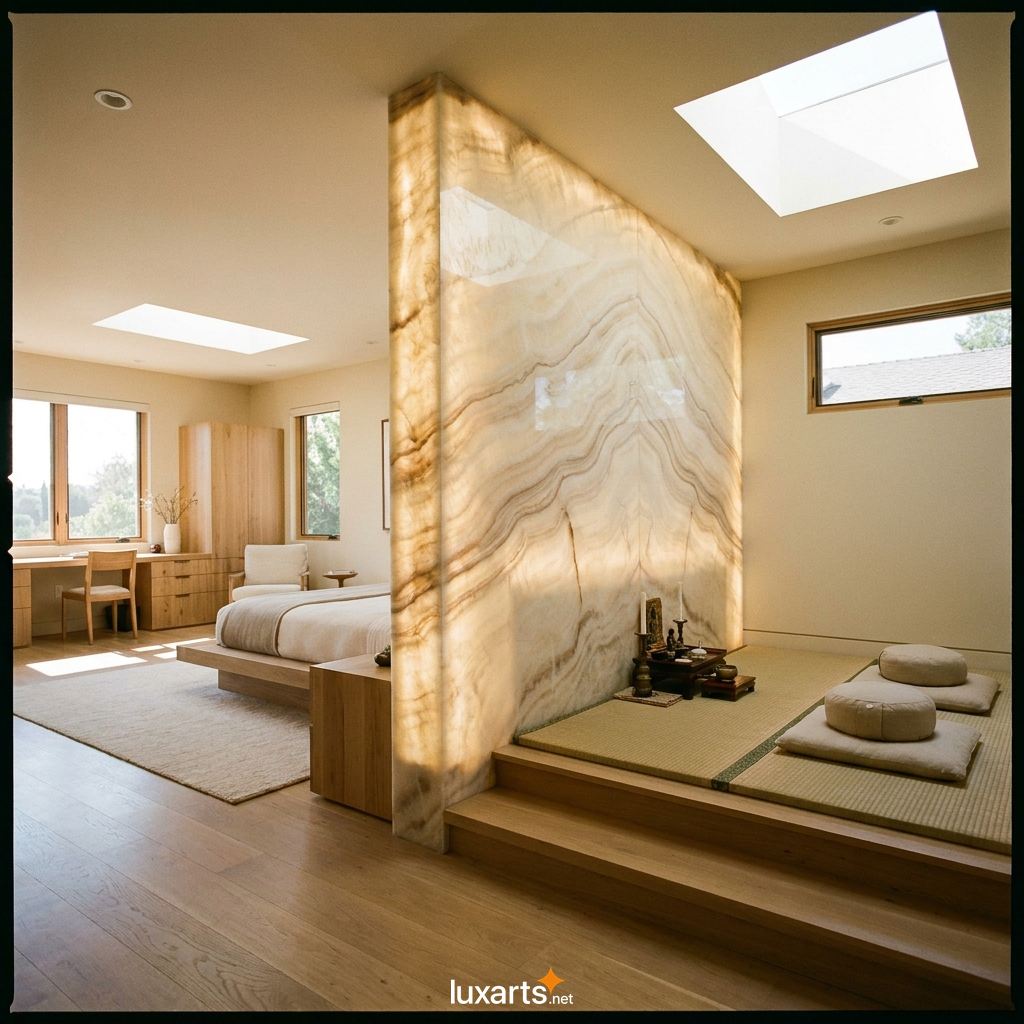
The contemporary bedroom is no longer the final stop in the body’s journey through a home — it is a transitional zone, where the boundaries with the bathroom, the balcony, the private meditation corner are deliberately blurred. Fixed partitions give way to layered, semi-open space: a thin, semi-translucent stone screen, a subtle change in floor elevation, a strip of light marking a boundary without a single physical wall. The body moves through these zones as a gradual ritual of preparation for sleep, rather than an abrupt switch from “active mode” to “rest mode” the moment the bedroom door slams shut.
We unpack this philosophy of breaking rigid geometry in full in Spatial Fluidity: Breaking the Rigid Geometry.
The Sonic Architecture Factor
In a densely urbanized world, silence has become a luxury commodity rarer than gold itself. Engineering true acoustic silence is never a matter of bolting on a soundproofing layer after a building is finished — that is a common failure that has doomed thousands of premium projects to fall short of real stillness. Engineering silence properly demands thinking in terms of density, mass, and the dissipation of sound waves from the very first structural drawing.
Double-layer walls with an air cavity calibrated precisely to a target frequency. Ceilings built from acoustic layers of differing density, designed to break reflected sound waves rather than merely absorb surface noise. Glazing built asymmetrically in thickness across its layers — a classic technique from professional recording studios, now applied to luxury sleeping spaces to eliminate frequency resonance. These are complex engineering principles, but the outcome they deliver is disarmingly simple: absolute stillness, a room where the brain is no longer forced to process the city’s background noise all night long.
Most residential acoustics treat silence as an afterthought — something addressed, if at all, by a heavier curtain or a thicker rug once the structure is already poured. That sequencing is backwards. Silence, like structural load, has to be engineered into the bones of a building before a single finish is chosen. A room can be draped in the finest textiles available and still fail this test completely, if the wall behind those textiles was never built to stop a frequency in the first place.
The full technical breakdown of this discipline appears in Sonic Architecture: Engineering the Silent Bedroom.
VI. The Anti-Trend: Critical Reflections on “Luxury”
The Sterile Fallacy
This has to be said bluntly, even at the risk of offending a fair portion of the high-end interior design world: the trend toward cold perfection — pristine white surfaces without a single mark, absolute monolithic lines, spaces that resemble showrooms rather than places anyone actually lives — is a dangerous misunderstanding of luxury itself.
A visually sterile room sends a clear subconscious signal: don’t touch me, leave no trace of yourself here. This is the architecture of distance, not the architecture of healing. Humans did not evolve to feel safe inside a sterile laboratory — we evolved to search for evidence of life, of time passing, of a story being told.
This is precisely why Wabi-Sabi — the appreciation of imperfection, of the trace time leaves on a material — needs to be reclaimed as a necessary anchor for the human spirit. A plank of wood with an asymmetric natural grain. A ceramic surface with an intentional crackle glaze. A hand-woven rug carrying small irregularities no machine could ever replicate. These “flaws” are not design failures — they are evidence of authenticity, the very thing that tethers the human mind to organic reality instead of letting it drift inside a space so digitally perfect it stops feeling human at all.
There is a reason five-star hospitality design abandoned pure minimalism years before residential design caught up. A guest can admire a flawless white suite for a weekend. A person who has to live inside that same suite for a decade starts, quietly and often without knowing why, to resent it. Perfection photographs beautifully and inhabits poorly — a distinction the most sophisticated clients of 2026 have already begun to feel in their own bodies, even before they can name it.
We examine this paradox further in The Sterile Fallacy: Why Cold Perfection Is Betraying the Concept of Luxury.

Cultural Preservation Without Clutter
A subtler challenge lies in curating a personal space that honors a homeowner’s history and memory without collapsing into visual noise. An inherited painting. A ceramic piece carrying the story of a journey. An old book with handwriting in the margins — these objects hold emotional value nothing can replace, but arranged without intent, they become visual interference, undoing the very stillness a room is meant to hold.
The real craft lies in ruthless selection — keeping only the objects that carry the deepest meaning, placing them inside a deliberately lit niche, turning each piece into a moment of quiet contemplation rather than one item lost inside a cluttered collection. This is the fundamental difference between a bedroom that functions as a refined personal museum and a bedroom that reads as an unsorted archive of memory.
We call this methodology “the ritualized chamber,” detailed in full in The Ritualized Chamber: The Art of Curating Memory in Sleep Spaces.
VII. Conclusion: Designing for the Decade Ahead
The journey we have just traced — from the neurological demands of geometry, to invisible ambient intelligence, to materials that genuinely breathe, to spatial fluidity, to the reclaiming of imperfect beauty — converges on a single point: the bedroom has stopped being passive space. It has become an active instrument of longevity, an engaged partner in the fight to reclaim the neurological health of modern life.
This is an invitation to every developer, every architect still hesitating: look at your home as a patient, and the person designing its space as a physician. Every decision about ceiling angle, about light color temperature, about the density of an acoustic material, is no longer a matter of taste — it is an architectural prescription, written specifically for one individual’s nervous system.
The future of luxury living will not be measured in square meters of imported marble. It will be measured in the minutes of deep sleep a room delivers, every single night.
Every other room in a home can afford to be a performance. The bedroom cannot. It is the one space with no audience, no visitor, no photograph to justify its cost — only a nervous system, alone in the dark, asking to be understood. Design it as anything less than that, and it was never luxury to begin with. It was only decoration, waiting for someone to notice the difference.
NOTE: All images in this post are AI-generated and intended solely for inspiration. These are not real products available for sale, and we do not operate any online store or website for purchases.