Smart Peacock Retractable Ceiling Fan with Lights for Living Room Decor
Introduction: When the Ceiling Becomes a Stage
A Peacock retractable ceiling fan with lights does something most ceiling fixtures never attempt: it changes character depending on the hour. Folded, it reads as a single perched bird hanging from a brass rod, its long tail drooping toward the room like a train of jeweled silk. Opened, the tail breaks into a ring of feather-shaped blades that sweep around the body, turning the ceiling into a slowly moving fan of green, bronze, and blue.
That dual personality is why this fixture has become a talking point in living rooms, lounges, and hotel lobbies. An ordinary fan is judged by how well it hides. This one is judged by how well it performs, and the photographs in this article show why. The bird sits at the center with enamel-blue plumage on its neck and chest, a patch of pearly crystals on its wing, and gilded feet gripping a small branch. Around it, every feather carries an eye-shaped marking in teal and bronze, while LED strips run along the blade spines to wash the room in warm or colored light.
Below, we look at the design in detail: how it is built, how the retractable feathers behave, how the lighting and smart controls work together, and where the fixture sits best in a living room. If you wonder whether an ornamental fan can share a ceiling with a carefully planned interior, the sections that follow should give you a clear picture.
What Sets a Peacock Retractable Ceiling Fan with Lights Apart from Ordinary Fans
Most ceiling fans follow a formula. There is a motor housing, three to five blades, and a light kit bolted underneath. They move air competently and fade into the background, which is exactly what their makers intended. The peacock design reverses that logic. The sculpture comes first, and the airflow is built into the sculpture.
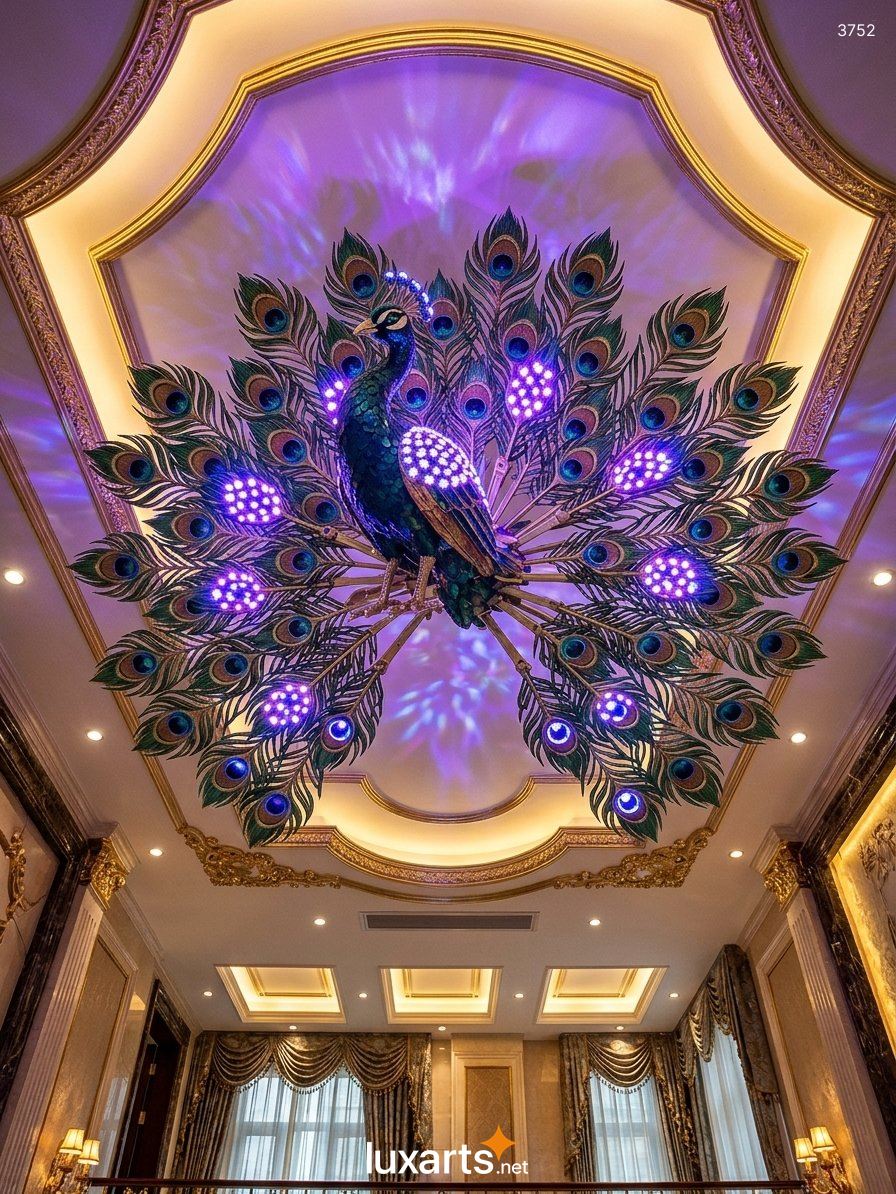
Look closely at the photographs and the difference in priorities becomes obvious. The blades are not generic paddles painted green. Each one is shaped like a real tail feather, with a slim central shaft, fine barbs splaying along both edges, and rounded eye markings repeating toward the tip. A ring of twelve or so blades produces dozens of eyespots in a single glance. When the fan is open, its silhouette looks closer to a heraldic crest than a household appliance.
The second difference is the word retractable. A conventional fan is always exposed, always the same size, always occupying the same patch of air above your head. A retractable one can shrink into a tidy vertical form when the room does not need airflow, which matters in living rooms where the ceiling is part of the view from the sofa. In the folded position, the fixture hangs like a pendant lamp with a bird perched on it, and a first-time visitor would rarely guess that a fan is hiding inside the tail.
Anatomy of the Design: Body, Feathers, and Metalwork
Start at the top. A polished gold canopy sits flush against the ceiling and hides the wiring connection. From it, a slim brass downrod drops toward the bird, giving the whole fixture a vertical spine that feels deliberate. The bird stands on a branch-like bar, and its finely cast claws match the finish of the rod and canopy, so all the metal parts read as one family.
The body is where the handwork shows. The neck and chest are covered in small overlapping scales in deep blue and green, glazed so they shift between sapphire and emerald as you walk around the room. A tiny crown of beaded crest feathers rises from the head, and the white and black markings around the eye give the face the alert look of a real peafowl. On the wing, a rounded patch of pearl-like crystals catches light and works as a quiet highlight even when the colored LEDs are off.
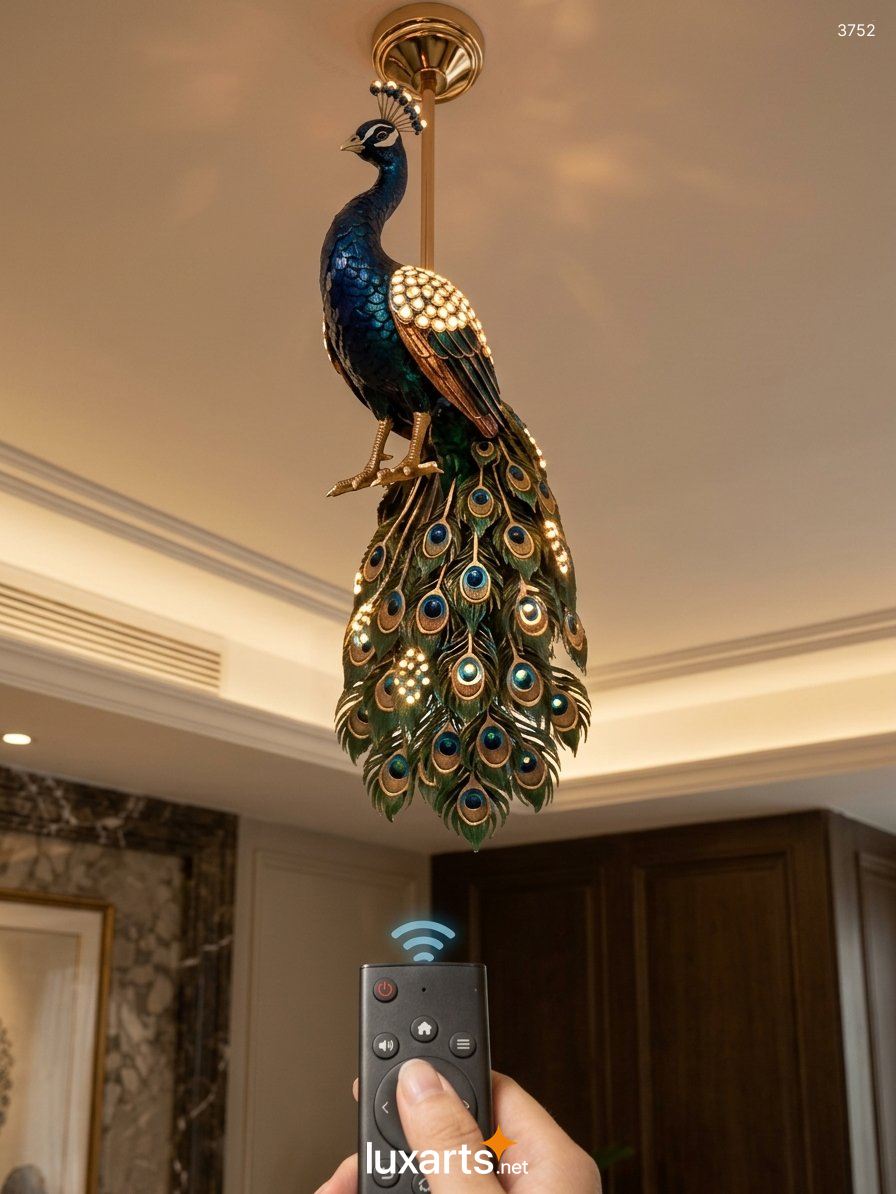
The tail is the largest element. In the folded state it falls in layers, each tier of feathers overlapping the next like roof tiles, with bronze-rimmed eyespots growing smaller toward the base. Dark green barbs frame every eye, and thin gold detailing along the shafts ties the feathers back to the metal parts above. When the fixture opens, those same feathers become the blades, so the beauty of the closed form carries straight into the open one.
How the Retractable Feather Mechanism Works in Daily Use
The photographs capture two clear states. In the first, the blades are gathered behind the bird and hang downward as one continuous tail. In the second, the blades swing outward on brass arms until they form a wide circle, with the bird in the middle like the hub of a wheel. The change between the two is triggered from a remote, so nobody needs a ladder or a pull chain.
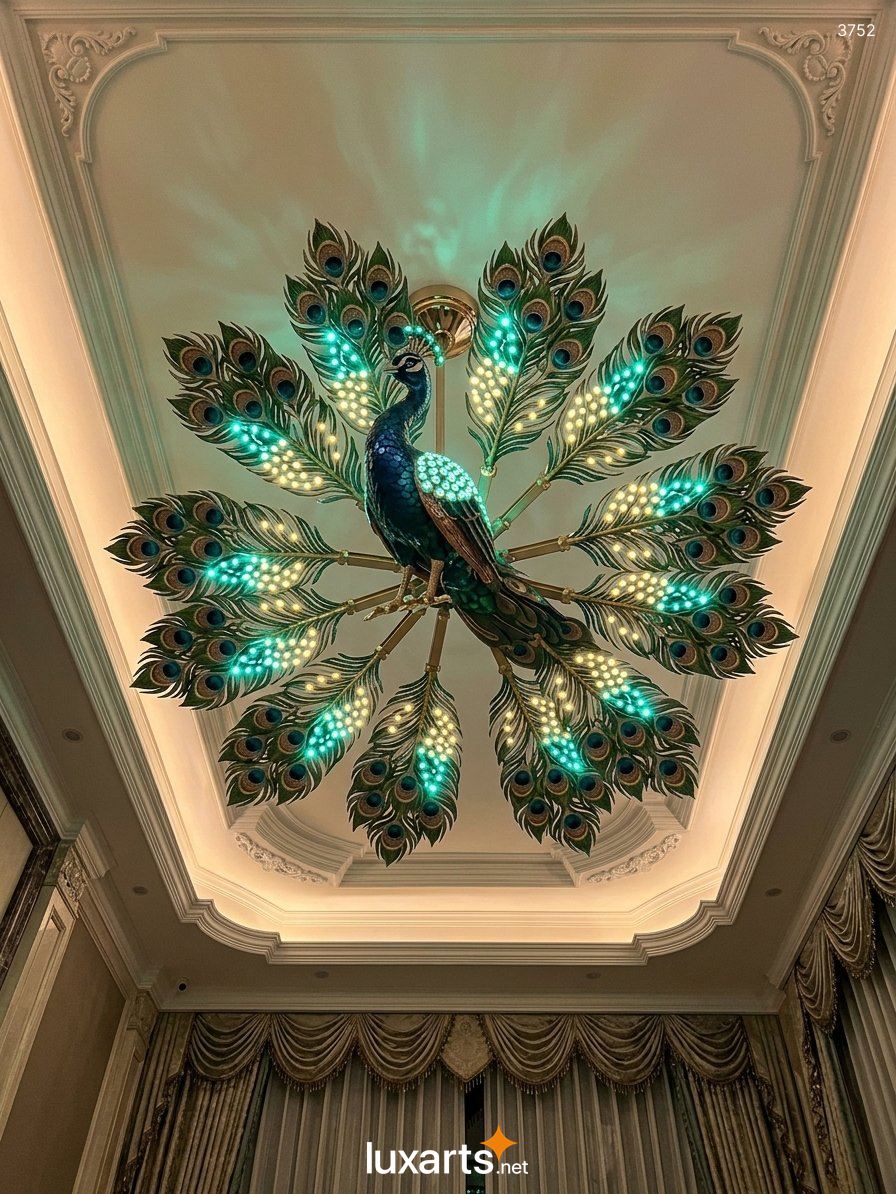
In daily life this creates a pleasant rhythm. On a mild morning the fan stays folded, and the living room simply has a bird hanging from the ceiling. When the afternoon turns warm, one press on the remote opens the feathers and sets the blades in motion. In the evening the blades can stay open with the lights on and the fan at rest, which gives the full peacock display without any air movement. Because the open and closed positions are separate from the lighting, you decide which combination suits the moment.
The folded position also has a quieter benefit. A closed tail occupies a narrow footprint, so the fixture can hang above a seating area or beside a low beam without feeling close to anyone’s head. That helps in rooms with moderate ceiling heights, where a fully extended ring of blades might feel too present all day long.
Lighting Modes: Warm White, Teal, and Color Washes
Lighting is the second half of the show, and the images reveal several distinct moods.
In the open position, rows of small LEDs run down the center of each feather blade. Some glow a soft warm white that flatters wood, fabric, and skin tones and suits conversation or casual reading. Others glow teal, which echoes the blue in the eyespots and makes the whole fan look as if it is lit from within. On each blade the two colors sit side by side, so the fixture delivers general illumination and decorative color at once.
Other photographs show deeper effects. In one, the bird glows violet and blue, and the light spills across a gilded ceiling as shifting reflections. In another, the folded fixture throws a mirrored pattern of green and blue feather shapes over a plain ceiling, almost like a projection of the tail onto the plaster. Those patterns change with your position in the room and create a sense of depth that a flat downlight cannot produce.
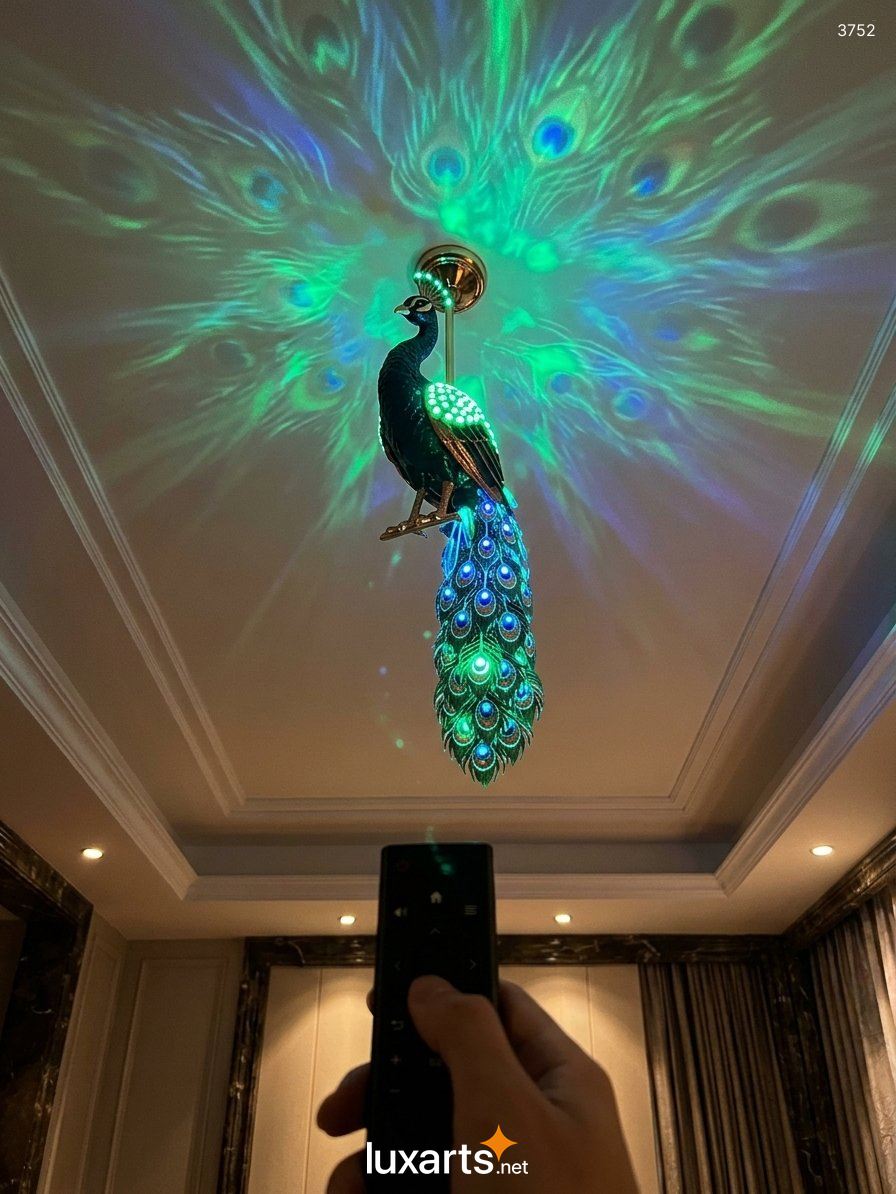
For a living room, a handful of lighting scenes tend to work best:
- Warm white only: for dinner, conversation, and relaxed evenings.
- Warm white low with teal accent: for television, music, or a quiet drink.
- Full color wash: for gatherings, when the ceiling is meant to be noticed.
- Lights off, fan running: for daytime airflow when the sculpture can stay in the background.
The peacock does not need to be on full display every minute. Dimmable, separately switchable light layers let it recede when the room wants calm and perform when the room wants attention.
Smart Control: Remote, Wireless, and Scene Settings
The word smart describes how the fixture is operated. Several photographs show a hand holding a slim remote beneath the ceiling, and one adds a small wireless signal icon above it. The message is simple: opening the feathers, changing the fan speed, and shifting the lights all happen from the sofa.
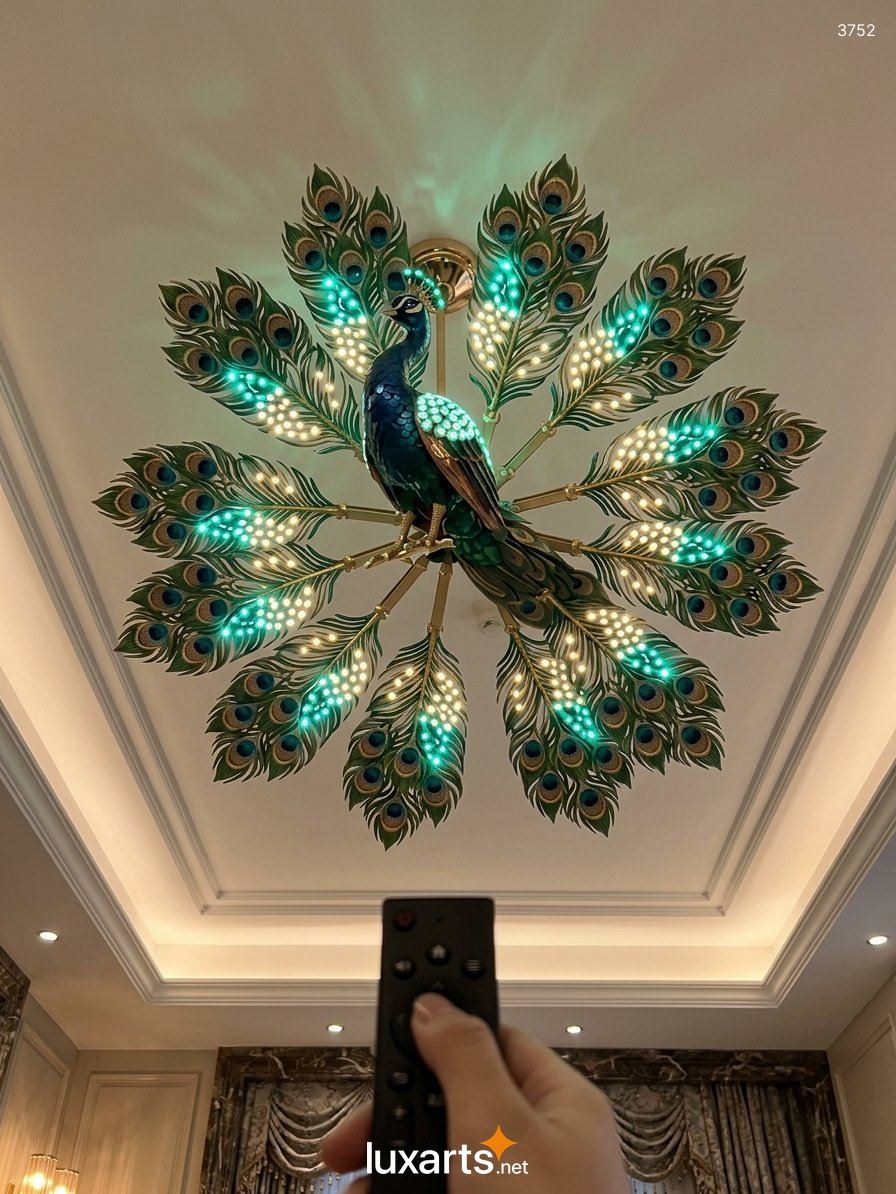
A single remote usually groups the essentials: power, fan speed, light brightness, color selection, and the open or fold command for the feathers. Depending on the model, the fixture may also pair with a phone app or a voice assistant through a wireless hub, which lets you combine commands into scenes. A “movie night” scene might fold the feathers, dim the warm white, and leave a faint teal glow. A “dinner” scene might open the blades at low speed with soft white light only.
Smart operation also changes how the fixture is used. A fan that requires a ladder or a wall switch tends to stay in one position for months. A fan that responds from a remote gets adjusted constantly, which means the retractable feature is actually used instead of being a novelty. Timers add another quiet convenience, since an open-plan living area can set the fan to wind down after an hour without anyone getting up.
Whichever control method you prefer, keep a spare remote battery on hand and learn the pairing steps before installation day. Small details like these decide whether a smart fixture feels effortless or irritating.
Airflow and Comfort in the Living Room
It is easy to get lost in the decoration and forget that this is still a fan. A ring of wide feather blades moves a large volume of air at modest speeds, which suits a living room better than a narrow-bladed machine spinning fast. In a sitting area, the goal is a gentle breeze that takes the edge off a warm evening, not a gust that lifts magazines off the coffee table.
Blade pitch, blade spacing, and rotation speed shape the feel of the airflow. Wide, gently angled feathers tend to push air downward in a soft column. Because the blades are arranged in a full circle around the bird, the movement spreads across the center of the room instead of concentrating in one corner. A ceiling with some breathing room above the blades helps the air circulate and keeps the sound low.
Noise matters in living spaces, where conversation and television compete for attention. Fixtures with a DC motor generally run more quietly than older AC designs, and well-balanced blades reduce the faint ticking that bothers people at low speeds. If the fan is going into an open-plan room, run it at every speed during the first few days and confirm that the sound stays in the background.
Fitting a Peacock Retractable Ceiling Fan with Lights into Different Living Room Styles
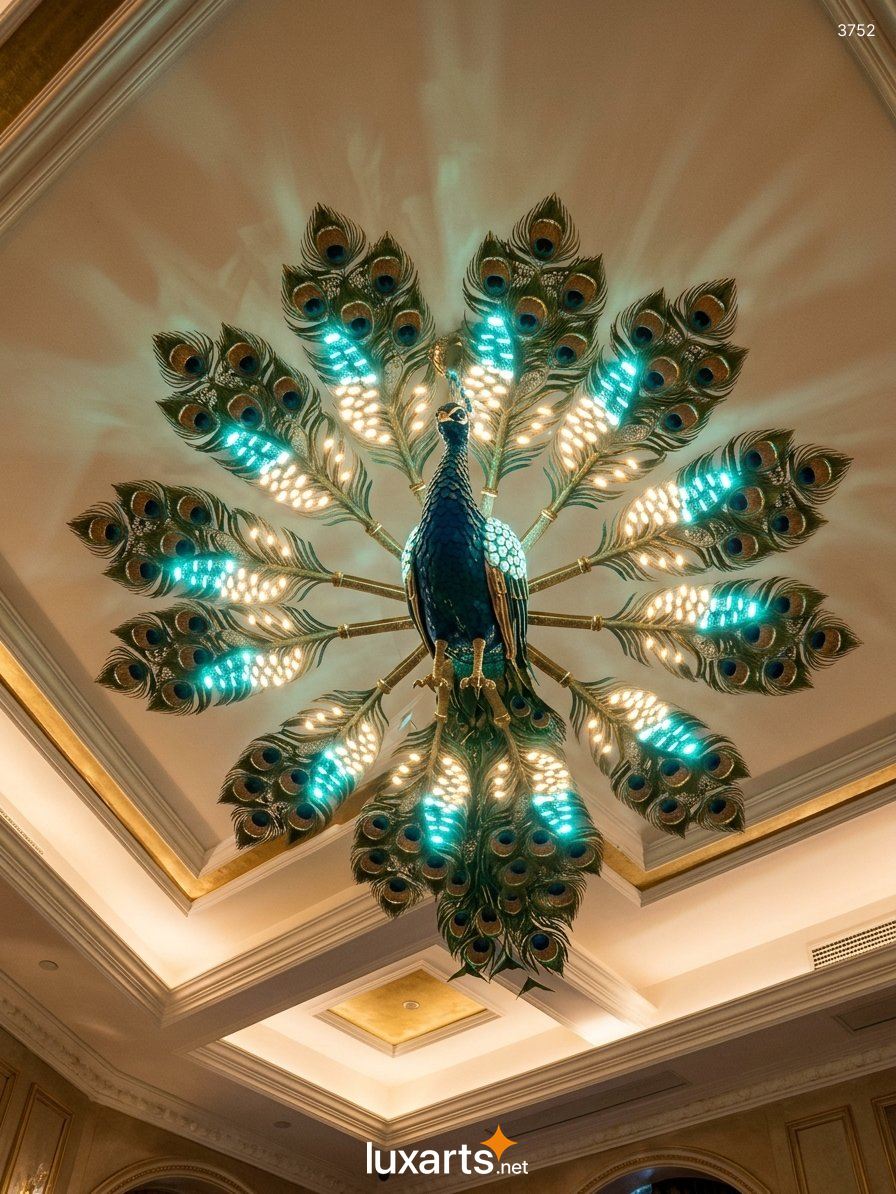
Ornate does not have to mean old-fashioned. The photographs show the peacock in rooms with gilded cornices, marble wall panels, silk drapes, and recessed ceilings, and it clearly suits that traditional richness. The same fixture can also work in other settings.
Classic and Neoclassical Rooms
Gold trim, a brass rod, and a jeweled wing echo cornices, picture frames, and curtain hardware. A ceiling with a recessed panel, like the ones seen in the images, gives the open tail a natural frame.
Eclectic and Maximalist Rooms
Layered patterns, velvet furniture, and bold wallpaper already invite a strong focal point. The peacock joins in without looking out of place, especially when the palette includes deep teal, emerald, or ink blue.
Modern Rooms with Warm Neutrals
Here the fan works as a single sculptural statement. Keep the walls quiet, avoid competing pendant lamps, and let the feathers supply the color. A cream or soft gray ceiling makes the green and blue stand out.
Whatever the style, the rule is restraint around it. One bold fixture needs calm neighbors. Matching the metal finishes, drawing one or two accent colors from the eyespots, and keeping other lighting simple will make the peacock look intentional.
Ceiling Height, Placement, and Room Proportions
Placement decides whether the fixture feels majestic or heavy. An open peacock spans a wide circle, and in the photographs it fills a good share of the ceiling panel it hangs in. That works when the ceiling has a defined center, such as a recessed tray, a coffered square, or a plaster medallion. The fan then sits inside a frame the architecture already provided.
Height is the other consideration. Common safety guidance for ceiling fans places the blades at least seven feet above the floor, and more clearance is better when the feathers are large and ornamental. In a room with an eight-foot ceiling, the folded peacock on a short downrod may be the more comfortable choice. Rooms with nine- or ten-foot ceilings, or double-height spaces, give the open version room to breathe.
Position the fan over the center of the seating group rather than the geometric center of the room if the two differ, so that people feel the breeze and see the display from their usual spots. Think about sightlines too. If the first view from the entrance runs toward the ceiling, the bird will greet every visitor, so it helps to turn its head toward the main approach.
Large Spaces: Lobbies, Lounges, and Double-Height Rooms
One photograph places an oversized peacock in a hotel-style lobby with marble columns, a curved staircase, and tall arched windows. At that scale the fixture behaves like a chandelier with a second job. The warm white lights along each feather read as a halo, and the teal sections add a cool accent that ties in with the daylight pouring through the glass.
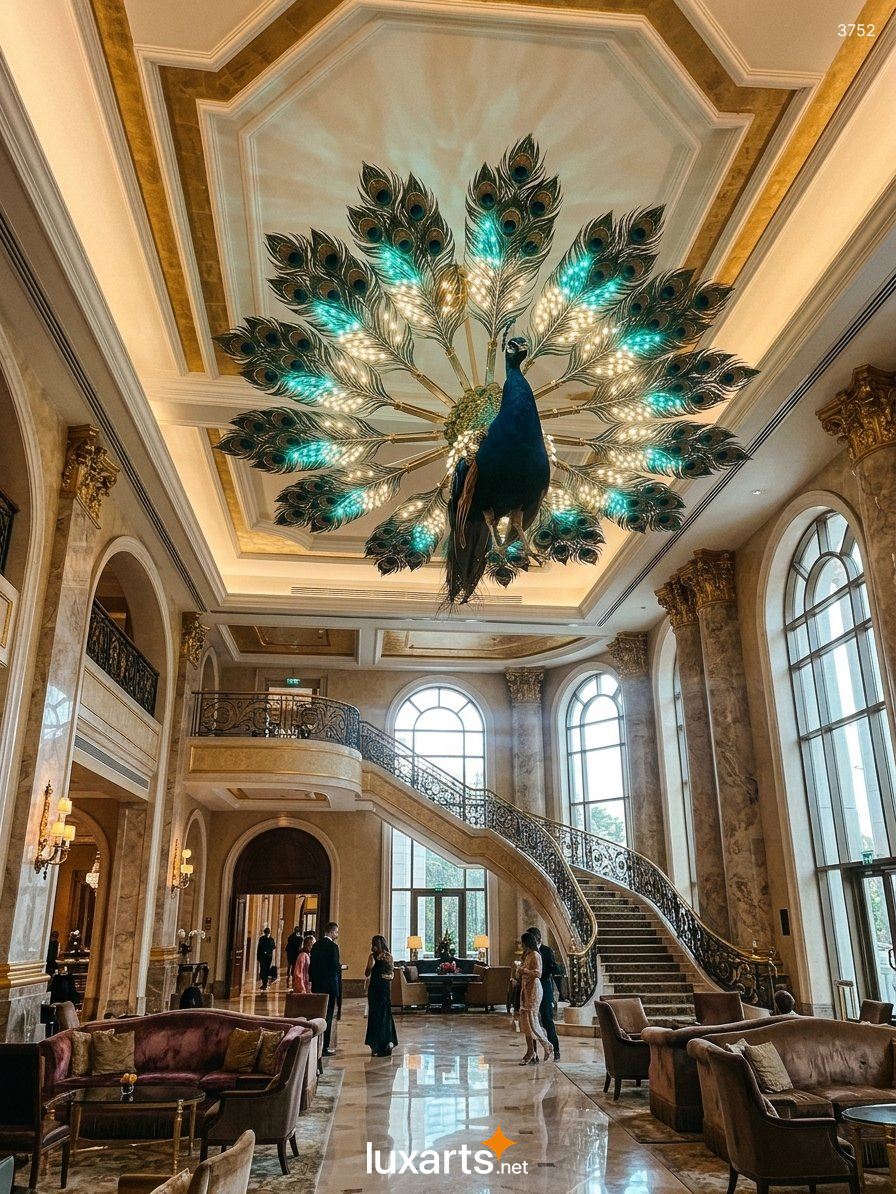
Living rooms with double-height ceilings, grand foyers, and open stair halls can borrow the same logic. In a space where a standard fan would look undersized, a wide peacock fills the vertical volume and gives the eye a place to land. People on an upper landing see it at close range, so the scaled chest and the pearly wing patch matter just as much as the open tail seen from below.
Larger installations call for engineered mounting and more planning, but the visual result is plain to see in the image: a ceiling that feels designed rather than simply finished.
Installation, Safety, and Maintenance Considerations
A sculptural fan carries more weight and more complexity than a plain one, so the practical side deserves real attention.
Mounting and Wiring
The fixture should be fixed to a structural support rated for its full weight plus the moving load of a spinning fan, not just to a standard light junction box. Fan-rated boxes and braces exist for this reason. A licensed electrician or qualified installer should handle the wiring, the remote receiver, and the ceiling attachment.
Balance and Alignment
Feather blades must match in weight and angle. Any wobble becomes more visible when the blades are long and decorative, so installers usually check balance before the final tightening.
Cleaning
The surfaces collect dust like any fan, but the eyespots, barbs, and crystals need gentle handling. Switch off the power first, then use a soft microfiber cloth or a fine-bristle brush to lift dust without scratching the enamel. Avoid spraying liquid directly onto the LED strips.
Periodic Checks
Every few months, look for loose screws on the blade arms, listen for new noises, and confirm that the feathers still open and fold smoothly. Catching a small issue early keeps the mechanism moving well for years.
Questions Homeowners Often Ask
Can the fixture serve as the only light source in a living room?
It can act as a strong mood and accent source, and the warm white LEDs give enough light for conversation. For reading and detailed tasks, most rooms still benefit from table lamps or wall lights. Treat the peacock as the centerpiece of the lighting plan rather than the whole plan.
Is the folded position enough for a lower ceiling?
The folded form is slimmer, but fan clearance rules still apply. Measure from the floor to the lowest feather tip, not to the bird’s body, and plan the downrod length from that number.
Does the colored lighting become tiring over time?
That depends on how it is used. Many people keep warm white for daily life and save teal and violet for evenings with guests. Independent light layers are what keep the fixture from becoming visually loud.
How does it sit alongside other statement pieces?
Two bold fixtures compete for the same attention. If the room already has a large chandelier or sculptural pendant, the peacock usually works best as a replacement for it rather than a neighbor.
Conclusion: A Fan That Behaves Like a Sculpture
The Peacock retractable ceiling fan with lights works because it treats the ceiling as part of the room’s story instead of leftover space. Folded, it is a bird at rest with a jeweled tail. Opened, it becomes a full display of feathers, light, and gentle airflow. Remote and smart controls make the change effortless, so the fixture adapts to morning, afternoon, and night without any fuss.
For a living room that already values craft, color, and a little drama, this kind of fixture combines practical comfort and a focal point in one piece of metalwork. Pay attention to ceiling height, mounting, and surrounding decor, keep the other lighting calm, and the peacock will carry the rest. Each time the feathers open, the room changes shape a little, and that is what a good ceiling fixture should do.
NOTE: All images in this post are AI-generated and intended solely for inspiration. These are not real products available for sale, and we do not operate any online store or website for purchases.