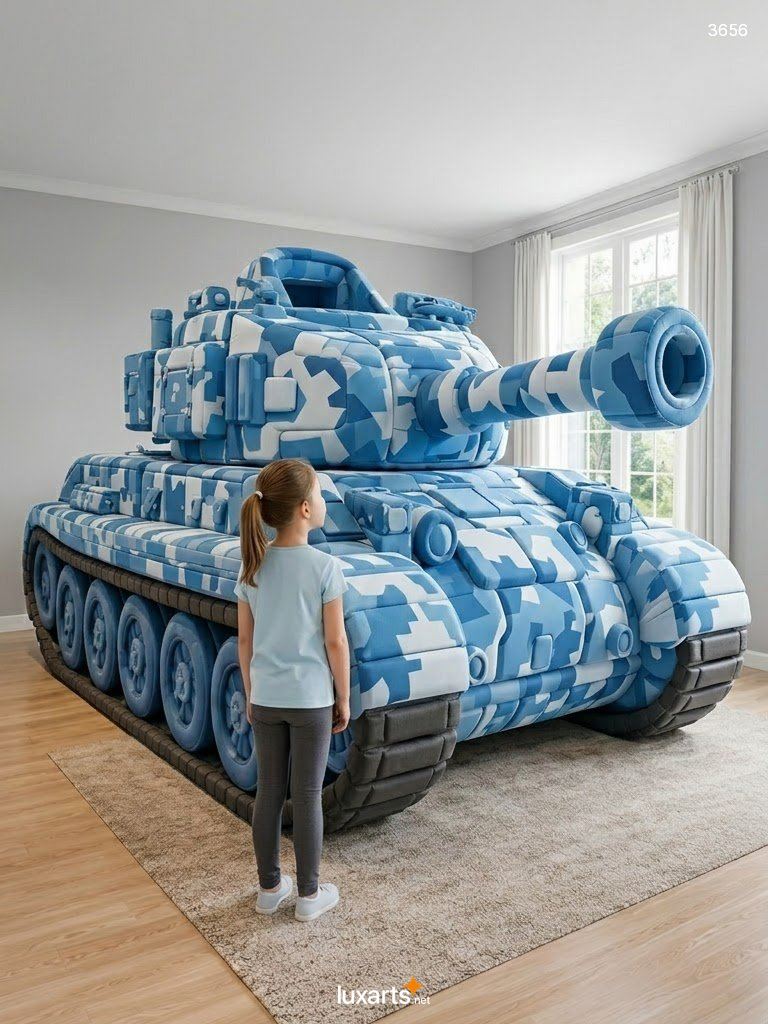
Walk into a bedroom that holds one of these builds and the first thing that happens is a full stop at the doorway. There’s a tank parked where a dresser should be. Tracks run along the floor, a turret sits up near the ceiling, and a barrel stretches halfway across the room. Then a kid climbs through a hatch on the side and disappears into a padded, camo-lined den that looks nothing like the armored shell surrounding it. That contrast — hard military silhouette on the outside, soft quilted bunk on the inside — is the whole idea behind Giant Foam Tank Kids Beds, and it’s worth walking through room by room, panel by panel, to see how the two sides come together.
First Impressions: A Tank That Fills the Room
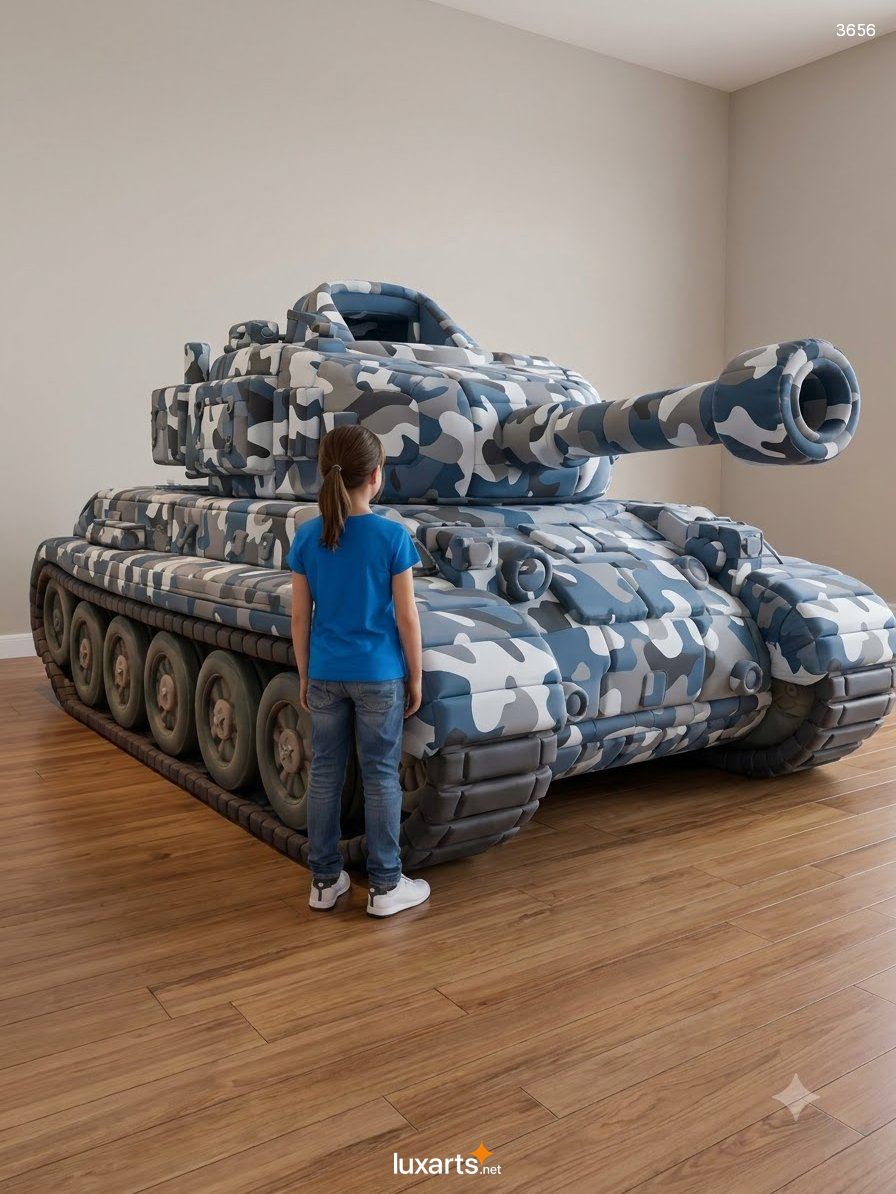
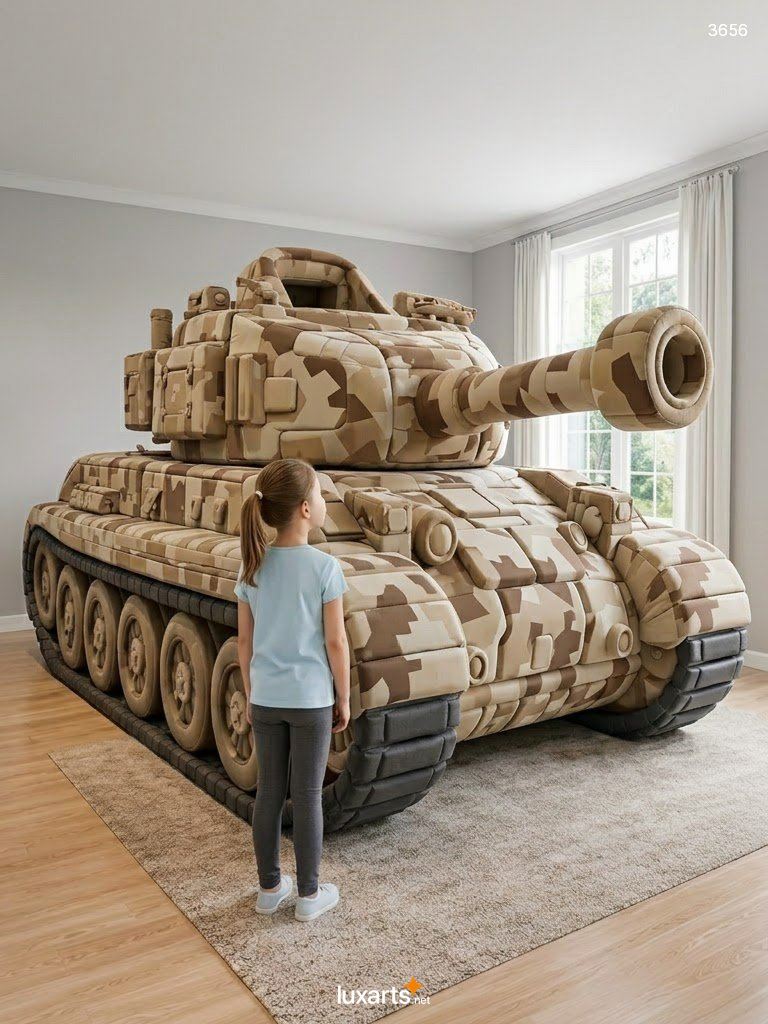
Scale is the first thing that registers. Next to an average seven or eight year old, the hull already reaches shoulder height, and the turret and raised barrel push the whole silhouette well above a standing adult. The proportions aren’t shrunk down or cartoonish — the tread wheels, the link-by-link track pattern, the side skirts, the hatch covers, and the raised periscope housing are all built to the scale of an actual armored vehicle, just formed from dense, carved foam instead of steel plating. The gun barrel isn’t a stub either; it extends out from the turret with a molded muzzle brake at the tip, so from across a room it reads as a real tank shape before anyone notices the material is soft.
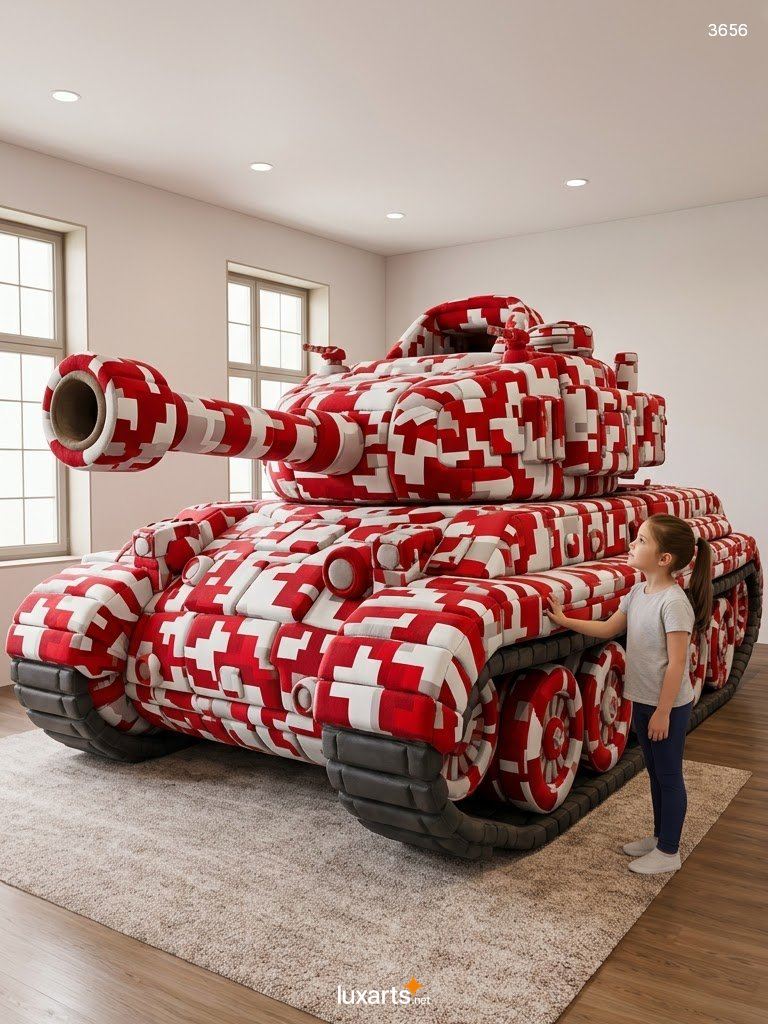
The camo skin is painted or dyed directly onto the foam surface in a pattern that changes with each build. One version uses a slate-and-steel blue arctic scheme, another goes with a sharp red-and-white digital pixel pattern, a third leans into a deep crimson blotch camo, and a fourth uses a tan-and-khaki desert scheme with soft brown blotches. Every panel line, weld seam, hinge, and rivet head is sculpted into the foam itself rather than printed flat, which is why the surface catches light and shadow the way a real hull would.
Stepping Through the Hatch: The Interior Tour Begins
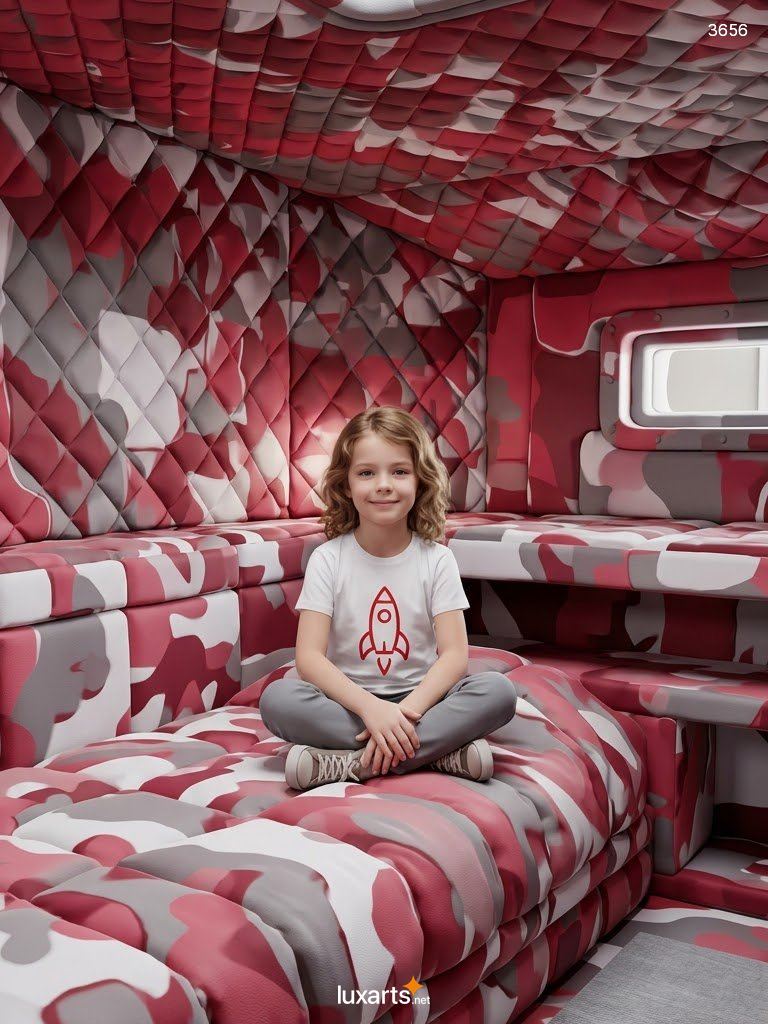
The transformation happens the moment a kid ducks through the side opening. Outside, the tank is armored and angular. Inside, every wall, every corner, and the entire ceiling are wrapped in soft, diamond-quilted padding, stitched in a repeating cross pattern that mirrors the camo tone from the exterior. There are no hard edges anywhere within reach — the padding wraps into the corners and curves up into the roofline, so the whole cabin feels closer to the inside of a plush travel case than the inside of a vehicle.
Two small round windows, shaped like ship portholes, are built into the side walls, each framed in a padded camo ring with a real pane of glass or acrylic set into the middle. A third opening sits overhead as a skylight, cut into the curved ceiling and trimmed with the same soft framing, letting daylight drop straight down into the bunk below. Between the two portholes and the skylight, the cabin never feels sealed off — there’s a real view out in three directions, which matters a lot for a space a child is going to spend time curled up inside.
The Sleeping Quarters
The bunk itself runs along the back of the cabin as a low, wide cushion built from the same quilted foam as the walls, thick enough to function as an actual mattress rather than a bench pad. A raised lip and side bolster border the sleeping area, forming a shallow nest that keeps bedding and pillows contained without boxing a child in. In the red colorway, a child sits cross-legged in the middle of that cushion with a rocket graphic on her shirt, and the bunk easily holds her with room to spread out a blanket or a few stuffed animals alongside her. A stepped ledge runs beside the bunk in some builds, giving a spot to set a book, a nightlight, or a stuffed animal without it rolling onto the floor.
Because the padding wraps continuously from floor to wall to ceiling, there isn’t a hard seam where a child’s shoulder or head would normally hit a wall panel. That continuous cushioning is really what turns “a tank replica” into “a bed” — the shape reads as a vehicle, but the surface a child actually touches, night after night, behaves like a mattress.
The Command Console: Where Imagination Takes Over
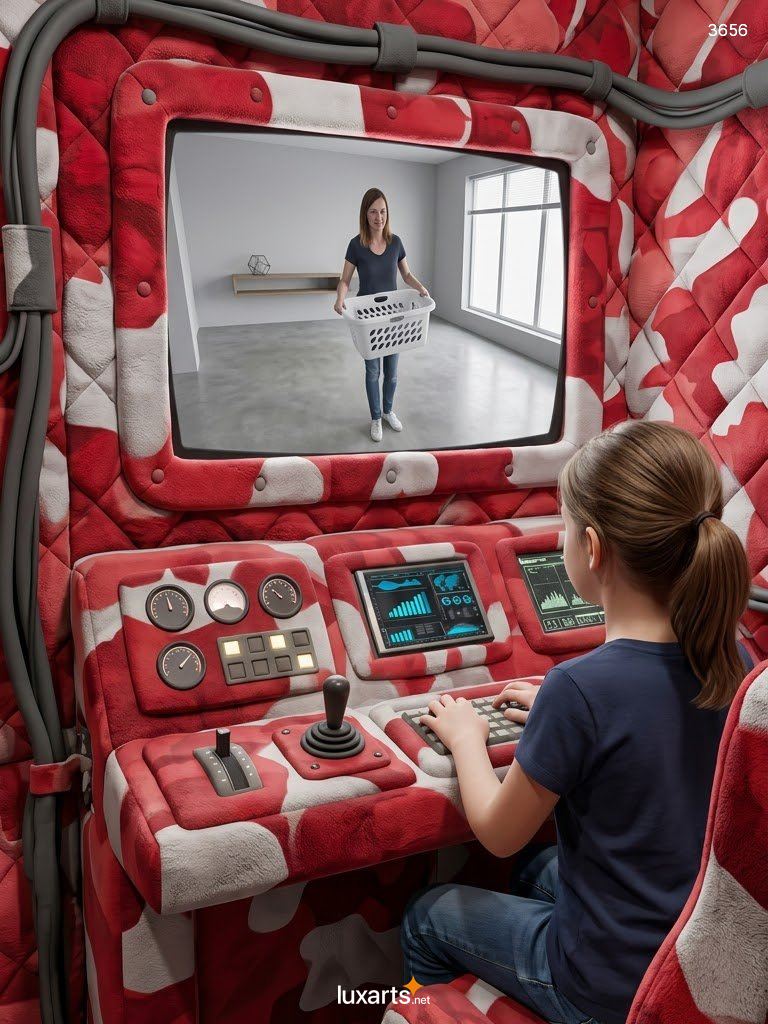
Tucked into the front corner of the cabin is a built-in console, styled to look like a driver’s station. A padded dashboard holds a cluster of round gauges, a bank of toggle switches, twin joysticks, and a small keyboard, all molded from foam and finished in matching camo upholstery. Two side screens display glowing readouts — waveforms, bar graphs, radar-style sweeps — giving the impression of a vehicle actively running rather than a static prop.
The centerpiece is a larger monitor mounted above the dash, framed in the same padded camo border as everything else. In use, a child sits at the console with hands on the keyboard, looking up at that screen the way a driver would check a display before heading out. It’s the detail that turns the tank from a piece of furniture into a stage set — a kid can sit down, flip a few switches, and run an entire mission without a single moving part actually needing to move.
Texture Talk: What the Foam Actually Feels Like
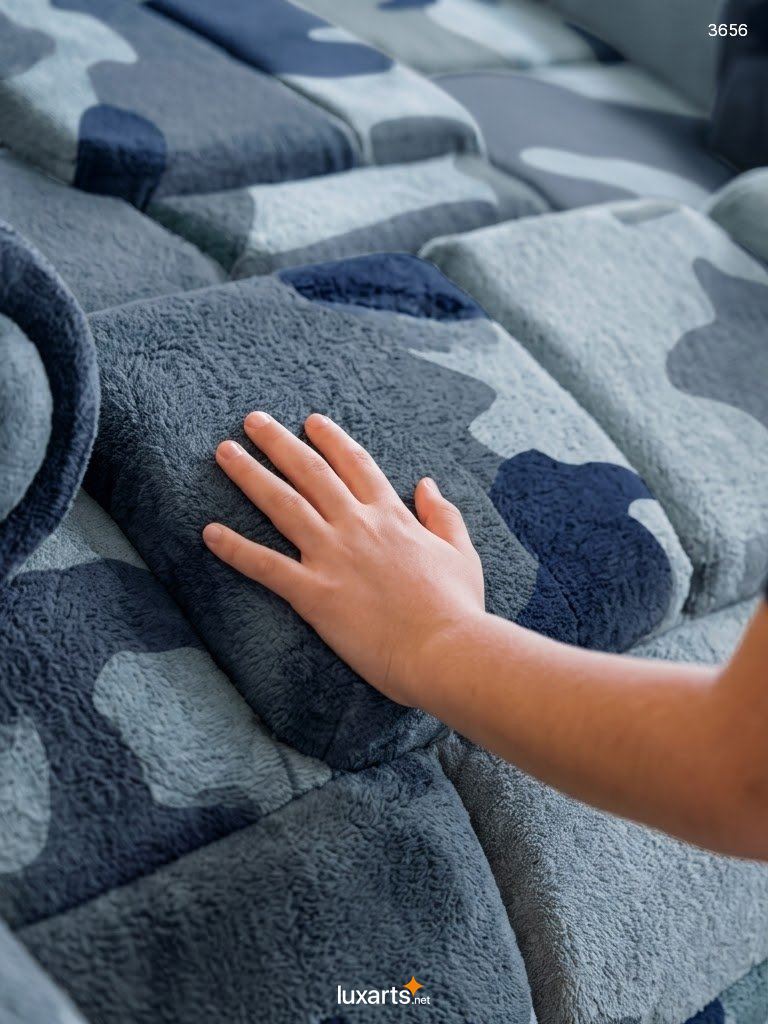
Close up, the surface has a soft, brushed finish, closer to a plush throw blanket than to standard upholstery fabric. In the arctic blue version, the camo pattern is dyed straight through a fleecy pile, so running a hand across it shows individual fibers catching the light along the blotch edges. The desert tan version has the same brushed texture but in warmer, sandier tones, with the pattern shifting from cream to a deep coffee brown across the same panel.
Underneath that surface layer, the padding itself has real depth and give — pressing down on any panel shows a firm but yielding foam core, enough resistance to keep its shape as a wall or ceiling panel, soft enough to lean a head against without discomfort. That combination is deliberate: too soft and the walls would sag out of shape over time, too firm and the whole point of a padded cabin is lost. The panels used here sit in the middle, holding their molded form while still functioning as something a child can flop against.
Camo Colorways: Choosing a Mission Theme
Because the same basic hull shape gets finished in different palettes, the mood of each build shifts quite a bit from one to the next. The blue-grey arctic scheme reads like a cold-weather outpost — steel blue, ash grey, and white blotches that suit a room done in cool tones. The crimson version leans warmer and louder, with a deep red base and grey-white accents that give the interior a bunker-at-sunset feel. The red digital pixel scheme trades soft blotches for sharp geometric blocks, giving it a more modern, almost video-game look. The desert tan build sits at the opposite end — quiet, sandy, and closer to a field vehicle than a combat one.
None of the four schemes changes the underlying construction; the hatch, the console, the bunk, and the padded walls stay in the same layout across every version. What changes is entirely the surface treatment, which means the choice really comes down to which palette fits the rest of the room and which mood a particular kid gravitates toward.
Built for an Actual Bedroom, Not Just a Showroom
Every scene in this lineup is staged inside an ordinary home — wood laminate flooring, plain painted walls, a window with sheer curtains, a low-pile area rug. That’s worth pointing out because it shows the tank isn’t designed for a dedicated playroom or a converted garage; it’s built to sit in a standard bedroom corner the same way a bunk bed or a loft bed would. The footprint is large, no question, but it’s a footprint meant to replace existing furniture rather than sit alongside it — once the tank is in place, it functions as the bed, the reading nook, and the play fort all at once, rather than adding one more piece to a room that already has a bed in it.
The rear or side hatch placement also matters for real-room use. A child needs to be able to climb in and out without contorting around a doorway or a piece of nearby furniture, and in every layout shown here the opening sits at a height and angle a young child can manage on their own, without needing a boost from a parent every time.
Safety Notes Worth Knowing
A few practical points come up naturally once the padding and layout are this close to a child’s daily use:
- Every interior surface within reach is padded foam rather than a rigid material, including the ceiling and the corners around the portholes.
- The console knobs, switches, and joysticks are molded from the same soft foam as the rest of the cabin, so they function as tactile play pieces rather than as anything with moving mechanical parts.
- The two side portholes and the roof skylight keep airflow and natural light reaching the bunk, which matters in an enclosed padded space.
- As with any enclosed sleeping nook, a parent should still do a normal check of the space — bedding, ventilation, and the hatch opening — the same way they would for a canopy bed or a loft bed.
Folding Down: What Happens Between Builds
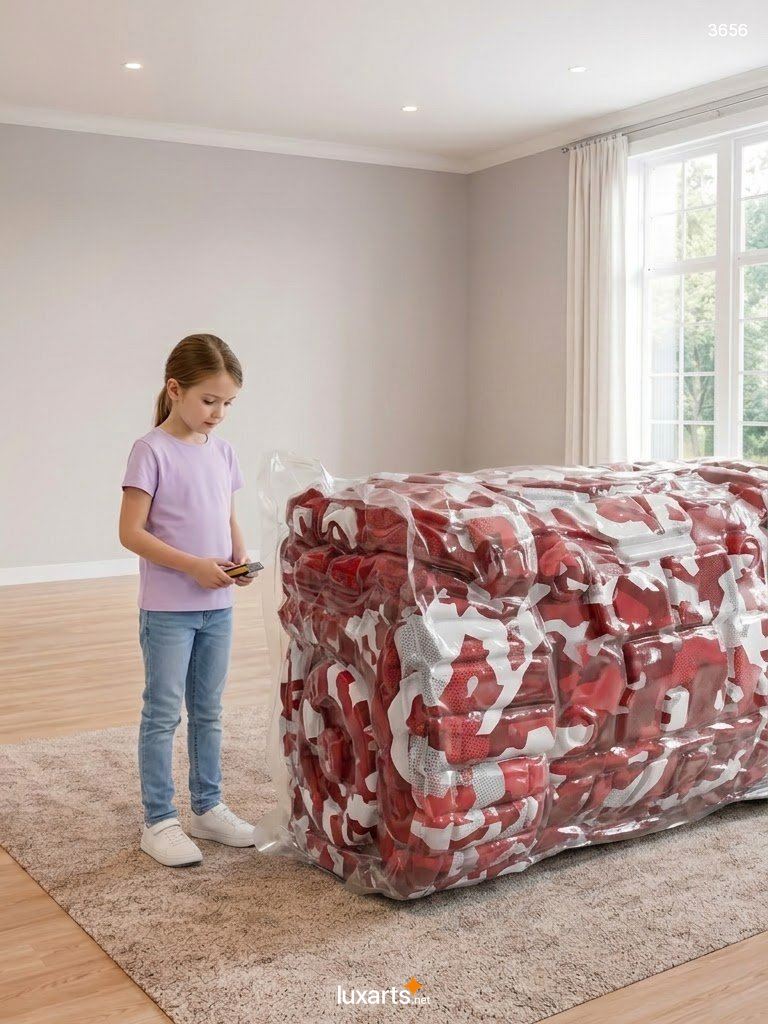
One image in this lineup shows the entire red camo tank compressed down into a soft-sided travel bag, vacuum-sealed flat with a zip closure, small enough for a child to stand next to and hold a remote control alongside it. That single picture answers a question most people have the moment they see the assembled size: the whole structure is not a permanent, rigid build. The foam panels compress down for storage or a move, then expand back out to the same tank shape once unpacked. For a piece of furniture this large, that fold-down step is what keeps it practical for an ordinary household rather than something that only works in a dedicated space.
Why Kids Gravitate Toward a Shape Like This
A bed shaped like a vehicle taps into a kind of play that a flat mattress never quite reaches. There’s a hatch to climb through, a console to sit at, windows to look out of, and a hull shape that reads instantly as “not just a bed” the moment a child walks in. That matters most at bedtime, when a room that already looks like an adventure is an easier sell than a plain rectangle against a wall. The padded, enclosed shape also gives a child a sense of a defined, contained space — something closer to a fort or a den than an open bed — which a lot of kids find calming rather than confining, especially once the novelty of the tank shape settles into a nightly routine.
The console adds a second layer on top of that. It’s not just a sleeping space; it’s a spot to sit upright during the day, flip a few switches, and run through whatever scenario a kid invents that afternoon, before climbing back to the bunk at the end of the day. That dual function — active play station by day, padded sleeping nook by night — is really what separates a themed bed like this from a standard novelty bed frame.
Wrapping Up the Tour
Seen from across the room, this is an armored vehicle scaled to fill a bedroom corner. Seen from inside the hatch, it’s a padded, quilted, window-lit bunk with a working console bolted to the front wall. The four camo finishes — arctic blue, crimson, red digital, and desert tan — give the same hull four very different moods, but the layout underneath stays consistent: a soft interior wrapped inside a hard-edged shell, built at a scale that actually works in a normal bedroom, and foldable enough to pack away when it’s time to move it. For a kid who wants their bed to double as a fort, a cockpit, and a hideout all in one, that’s the appeal in a single sentence — and it’s easier to see after walking through the hatch than it
NOTE: All images in this post are AI-generated and intended solely for inspiration. These are not real products available for sale, and we do not operate any online store or website for purchases.